Ask the coach
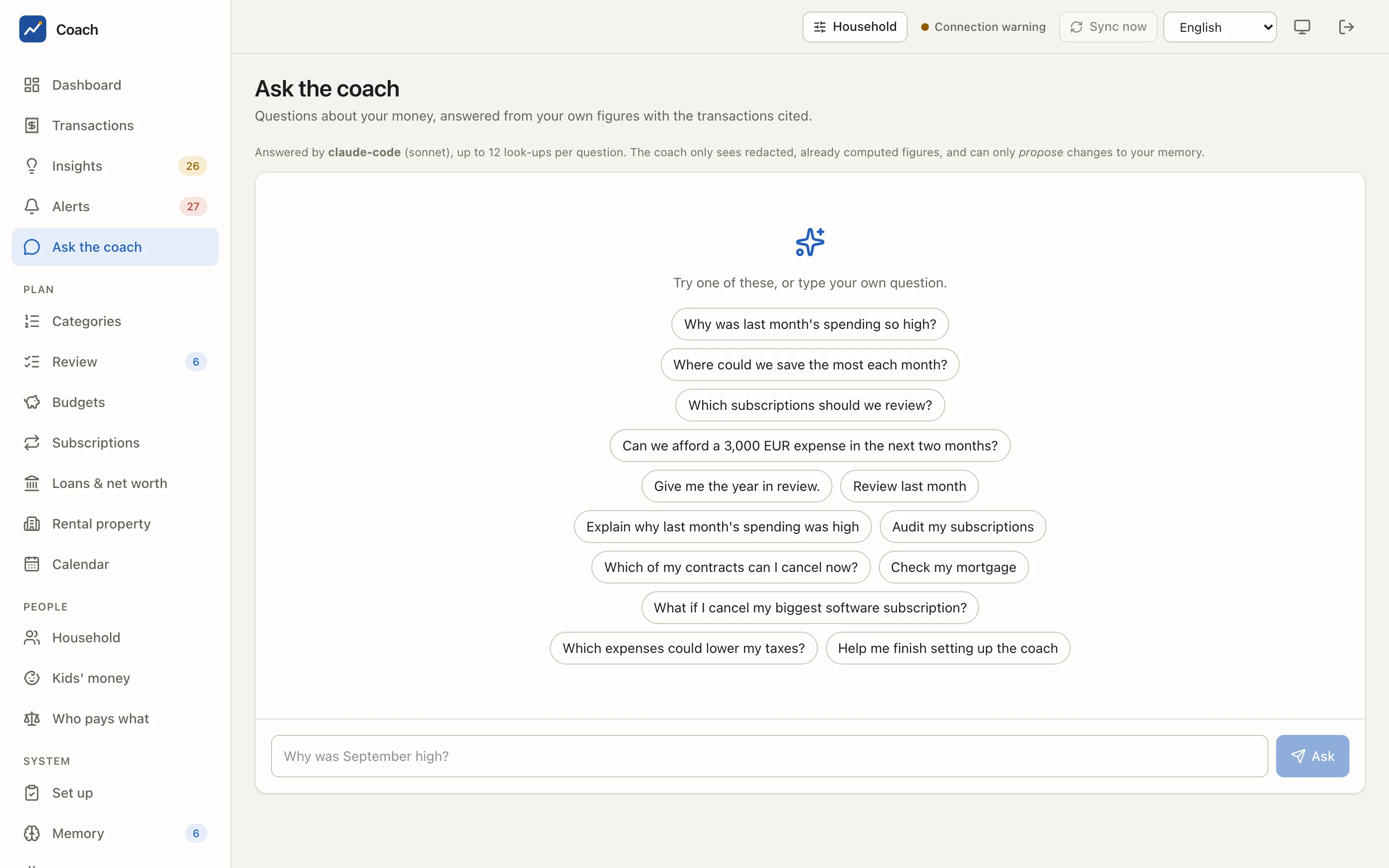
Ask a question about your money in plain words and get an answer built from your own figures, with the transactions it is based on.
The one rule: numbers come from code, words come from the model
The coach never reads your bank statements. It calls a set of finance tools that compute the figures (averages, cash flow, recurring payments, anomalies, forecast...) and return them redacted. The model's job is to pick the right tools, read their results and explain them. It is told never to compute a number itself, and every number it writes is checked against what the tools returned.
flowchart LR
  Q[Your question] --> M[The model]
  M -- "calls a tool" --> T[Finance tools<br/>compute on your data]
  T -- "redacted result:<br/>pseudonyms, hashed refs" --> M
  M --> A[Answer with evidence chips]
  A -- "click a chip" --> R[The real transaction,<br/>resolved on your machine]
What you see
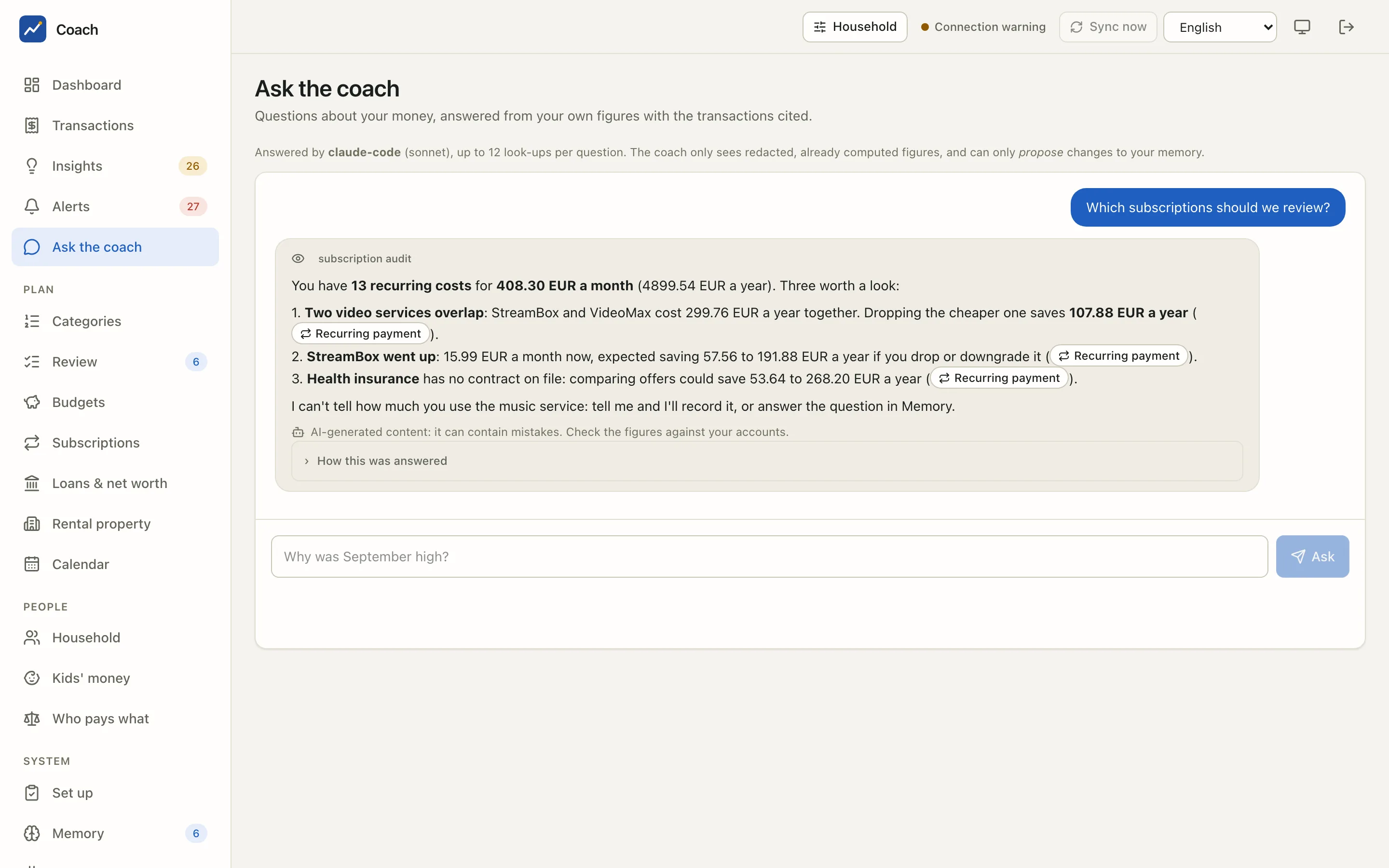
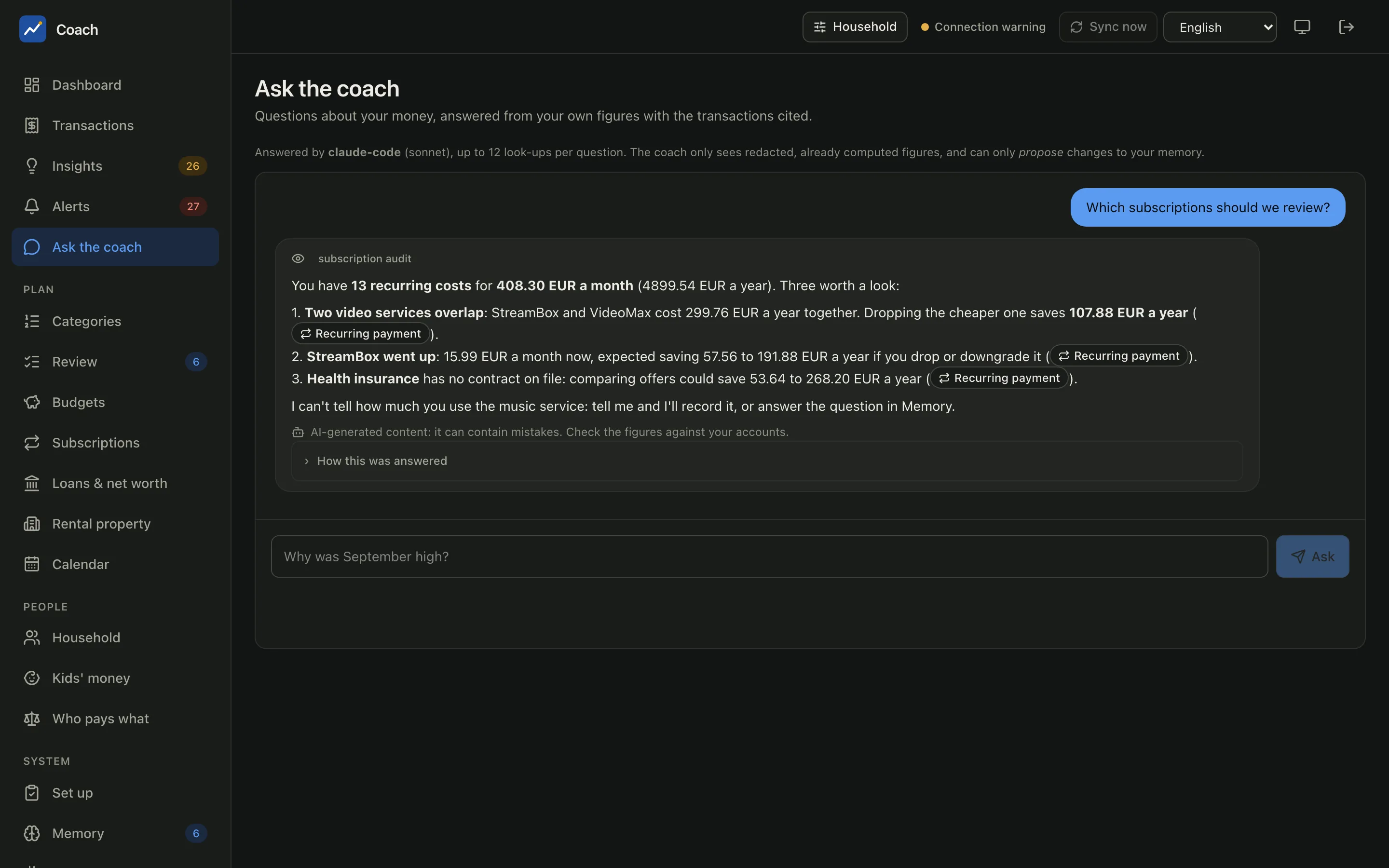
The line under the title says which backend and model answer, and how many look-ups a question may use (for example "Answered by claude-code (sonnet), up to 12 look-ups per question").
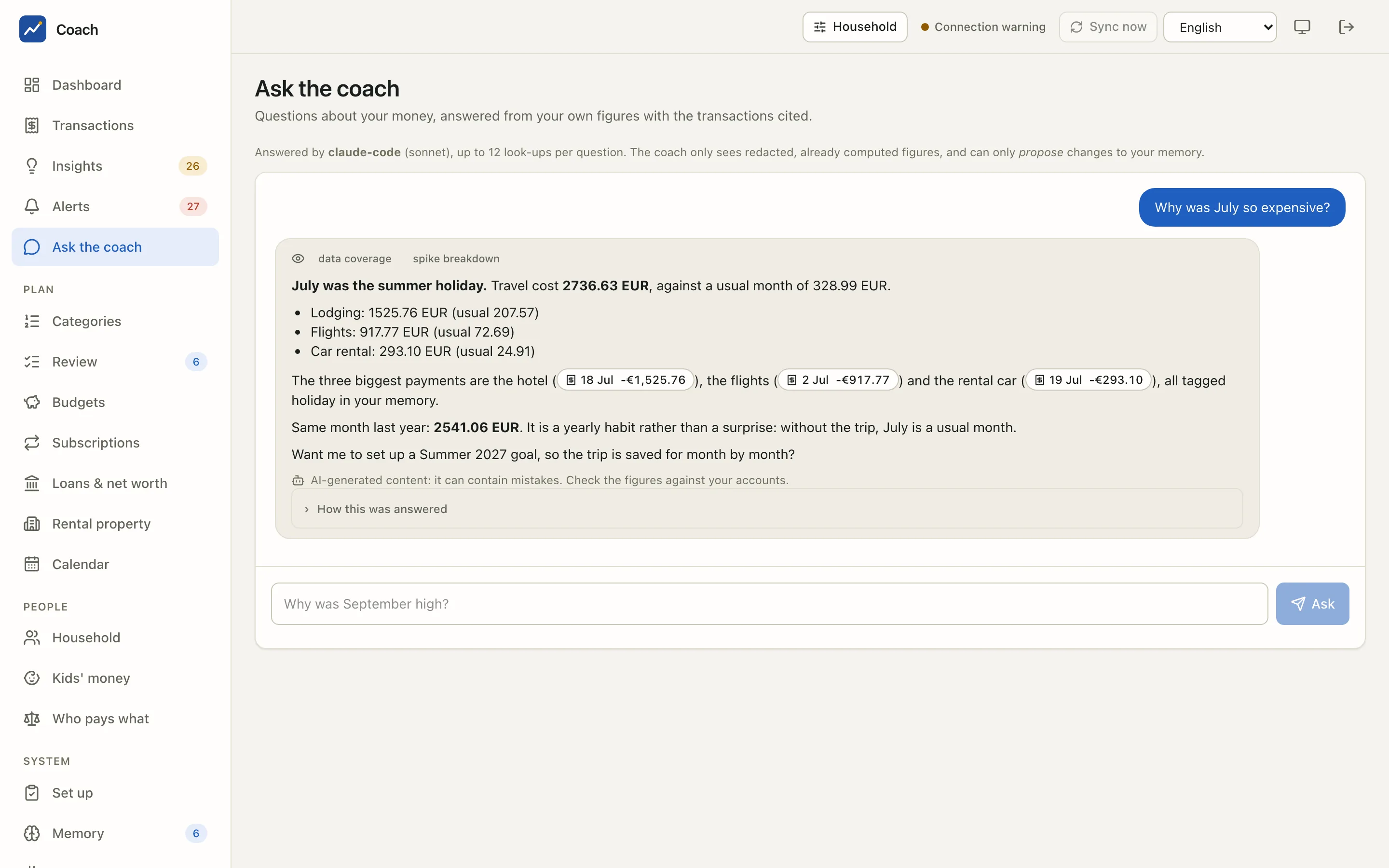
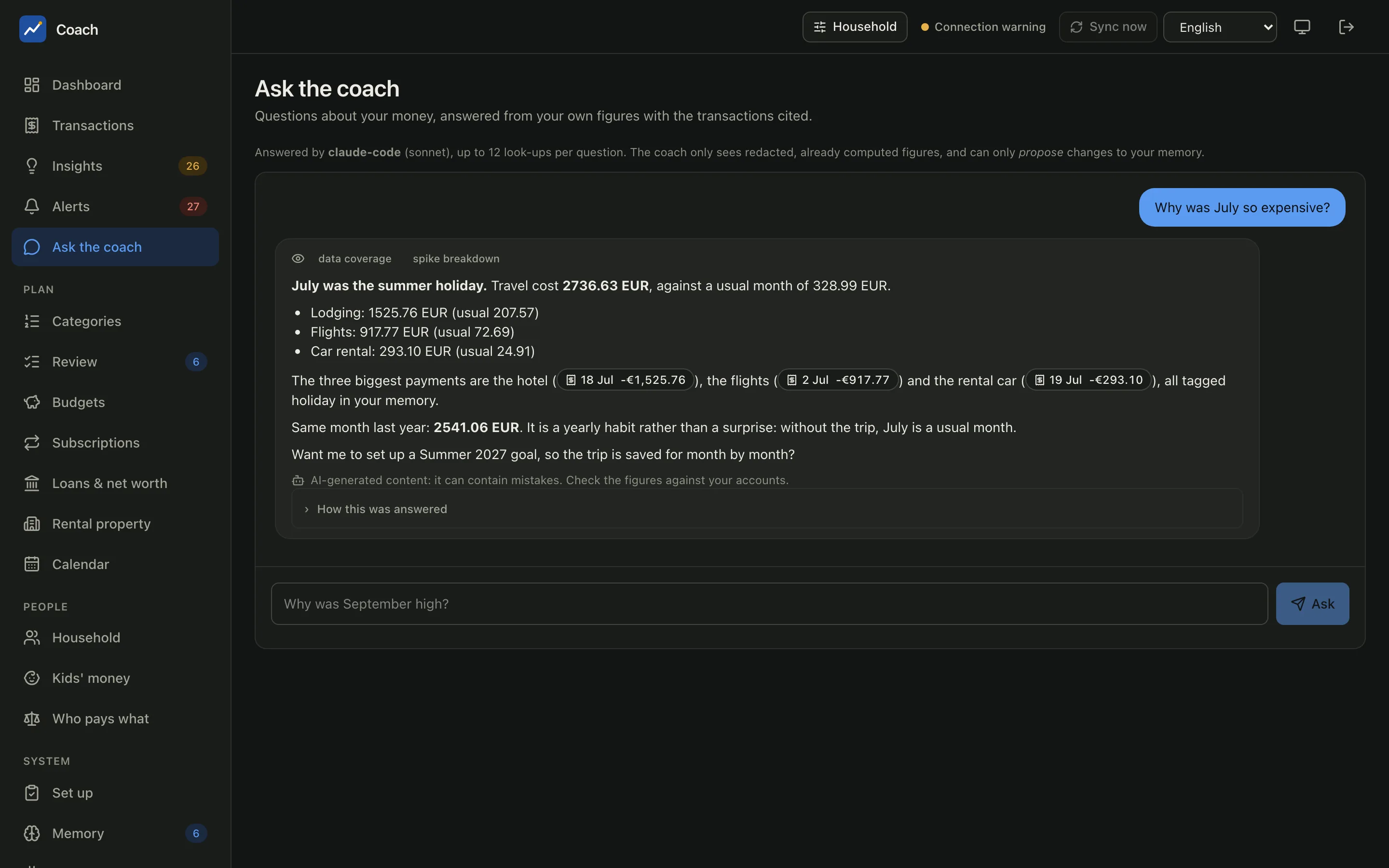
An answer has these parts, from top to bottom:
- What the coach looked at. Next to the eye icon, one badge per tool it called: "data coverage", "spike breakdown", "subscription audit"... While it works you see "Looking at your figures…".
- The answer, streamed as it is written.
- Evidence chips. A chip with a date and an amount (
18 Jul -€1,525.76) is a transaction: click it to open that transaction in Transactions. A Recurring payment chip opens the series. The mapping from the model's reference to the real transaction happens on your machine; the model never knows which transaction it was. - The AI-generated label: "AI-generated content: it can contain mistakes. Check the figures against your accounts."
- How this was answered (click to open): backend, model, number of look-ups, tokens in and out, an approximate cost (notional on a subscription) and the time it took.
Some answers carry extra notices:
| Notice | What it means |
|---|---|
| "N numbers in this answer could not be traced to a computed figure" | a number did not appear in any tool result. Often a sum the model made: check it before relying on it |
| General information only | the answer touched on investment products. The banner reminds you it is not personalised investment advice; for a specific product, ask a regulated adviser |
| Suspicious text in your data | a merchant name or description looked like an instruction aimed at the coach. It was treated as data and ignored |
| Proposal p-...: nothing is changed yet | the coach suggests a change to your memory. See below |
While a question runs, the Ask button becomes Cancel. The coach answers one question at a time, and each question stands alone: it does not remember the previous one, so put the whole context in your question.
What you see vs what the model sees
Every tool result is rewritten before the model reads it. Here is how the demo household looks on each side:
| You see (in the app) | The model sees |
|---|---|
| Anna Rossi | adult-1 |
| Mia Rossi | kid-1 |
| Joint account | account-main-1 |
| A transaction (18 Jul, -1,525.76 at Hotel Miramare) | h_xxxxxxxxxx, with its date, amount and category |
| A small local shop | [merchant:food.groceries]-xxxxxx |
| The payer of a salary | [employer] |
| A school you declared | [school] |
Subscriptions, bills and businesses you pay often (StreamBox, TelcoCo...) keep their name; person-like names and small unknown businesses are generalised. Every free-text value is wrapped and marked as untrusted, so a merchant called "ignore your instructions" stays a merchant name. A last check runs on every output: if a member name, an account label, an IBAN, an e-mail or a path slipped through, the whole result is withheld.
Coarse and standard
[privacy] model_detail = "coarse" (the default) generalises the most. "standard" keeps more merchant names and lets the coach read
your coach rules in preferences.md. Names of people are scrubbed in both. See Privacy modes.
Questions to try
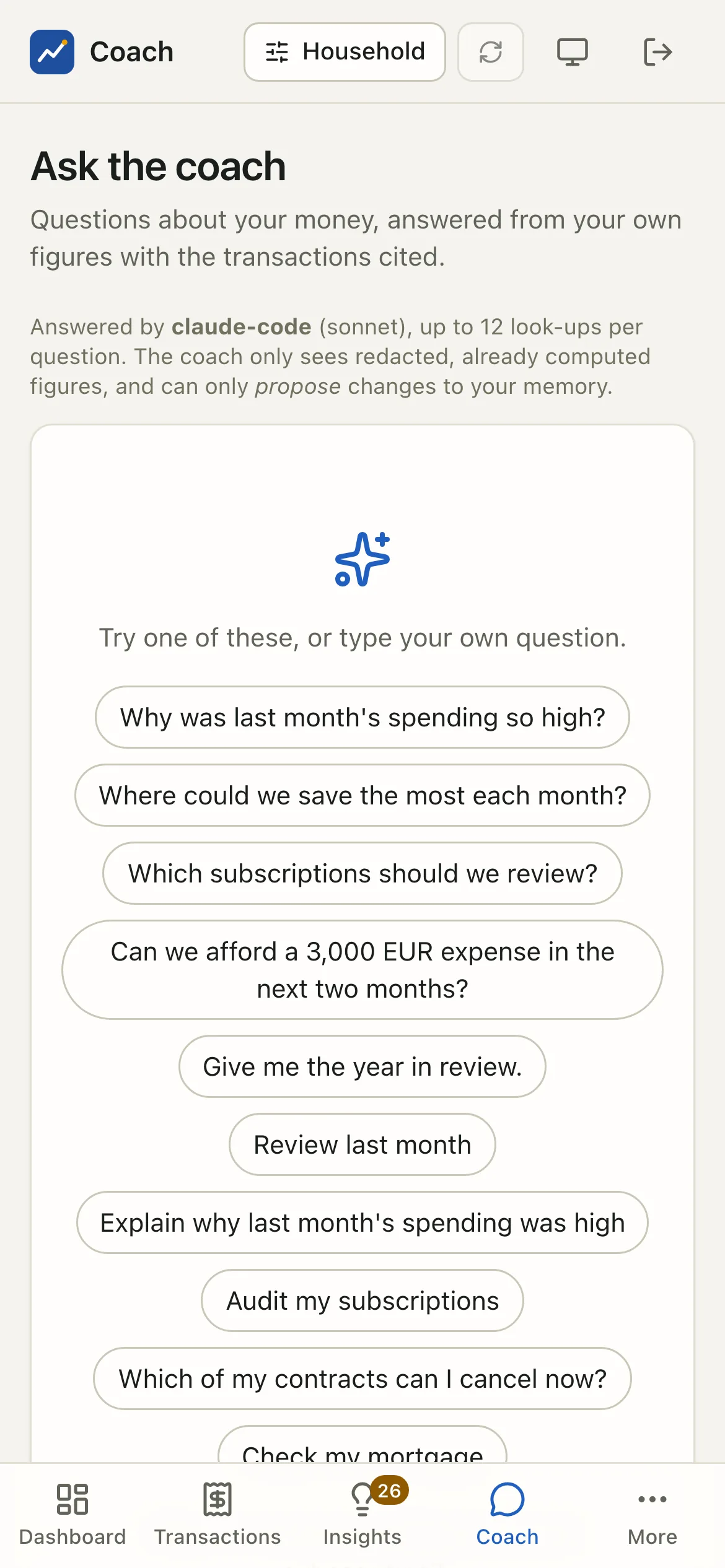
The suggested questions of the page are a good start. Some of them run a ready-made skill (hover to see which one):
- Why was last month's spending so high?
- Where could we save the most each month?
- Which subscriptions should we review?
- Can we afford a 3,000 EUR expense in the next two months?
- Give me the year in review.
- Review last month
- Explain why last month's spending was high
- Audit my subscriptions
- Which of my contracts can I cancel now?
- Check my mortgage
- What if I cancel my biggest software subscription?
- Which expenses could lower my taxes?
- Help me finish setting up the coach
The coach proposes, you decide
The coach cannot change anything about your household. When an answer suggests a change ("the yearly statement gives a newer value"), it creates a proposal: a sealed, validated diff. The answer shows its id and the command to run.
- Review the diff in Memory > Proposals.
- Accept it yourself, in your own terminal:
uv run coach memory accept p-.... The command shows the diff again and asks you to type a confirmation.
There is no button to accept a proposal in the web app, on purpose: nothing that reaches the page can write into your memory.
Which model answers
The [coach] backend setting chooses who answers:
| Backend | In short |
|---|---|
claude-code (default) |
headless Claude Code on your own Claude subscription; for a few personal questions a day |
anthropic-api |
the Anthropic API with your API key, billed per token |
openai-compatible |
OpenRouter, Eden AI or a self-hosted server such as vLLM; the model must support tool calling |
ollama |
a local model on this machine; nothing leaves it. The model must support tool calling |
Set-up, keys and costs: AI models. Every question is logged in AI usage.
Digests: the coach writes to you (opt-in)
With [coach] schedule_weekly = true (and schedule_monthly = true) the daily job also asks the coach for a weekly digest and a monthly
review, but only when there is new data since the last one. They land in Insights with their evidence. Both are off
by default.
From the terminal
uv run coach coach ask "Why was September high?"
uv run coach coach ask --skill monthly-review --month 2026-09
uv run coach coach skills                         # the skills and how to run them
uv run coach coach digest --weekly --dry-run      # the exact prompts and redacted tool outputs; no model is called
coach coach ask uses the same tools, the same redaction and the same checks as the web page. It never searches the web.
Good to know
- No investment-product advice: the coach coaches budgeting, spending and saving habits. It names no fund, share, lender or insurer.
- If a figure is not available, the coach should say so rather than guess. If it guesses anyway, the unverified-number warning shows it.
- Answers are kept as insights of kind Answer, so you can find them again in Insights.
See also
- Coach reference: the tools, the privacy model, prompt-injection protection, backends and costs.
- Privacy reference: every path data can take out of this machine.
- Skills reference: what each ready-made analysis does.