Daily job & backups
One daily job keeps everything fresh: it syncs your banks, categorizes the new transactions, refreshes the analytics and checks for alerts.
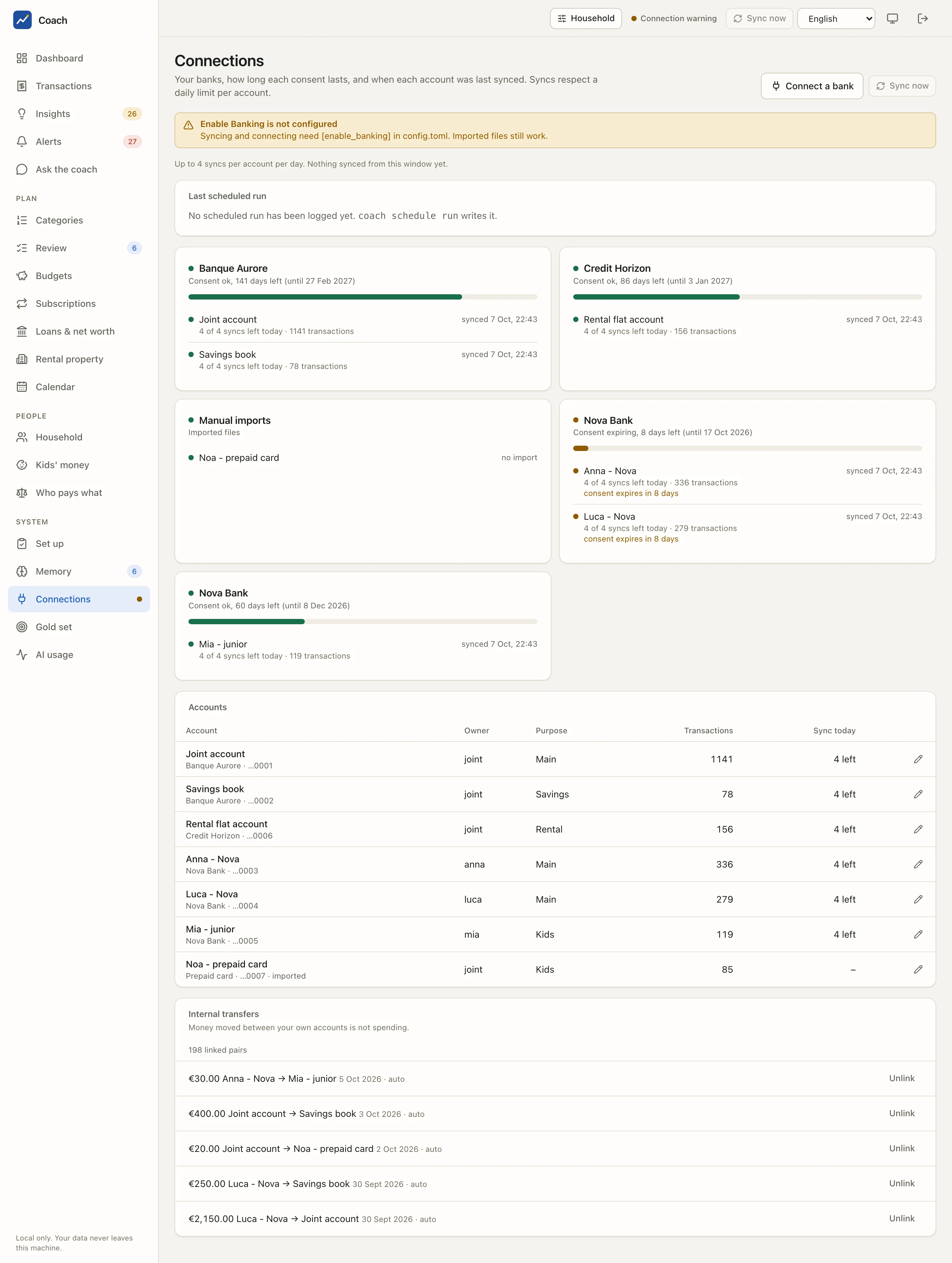
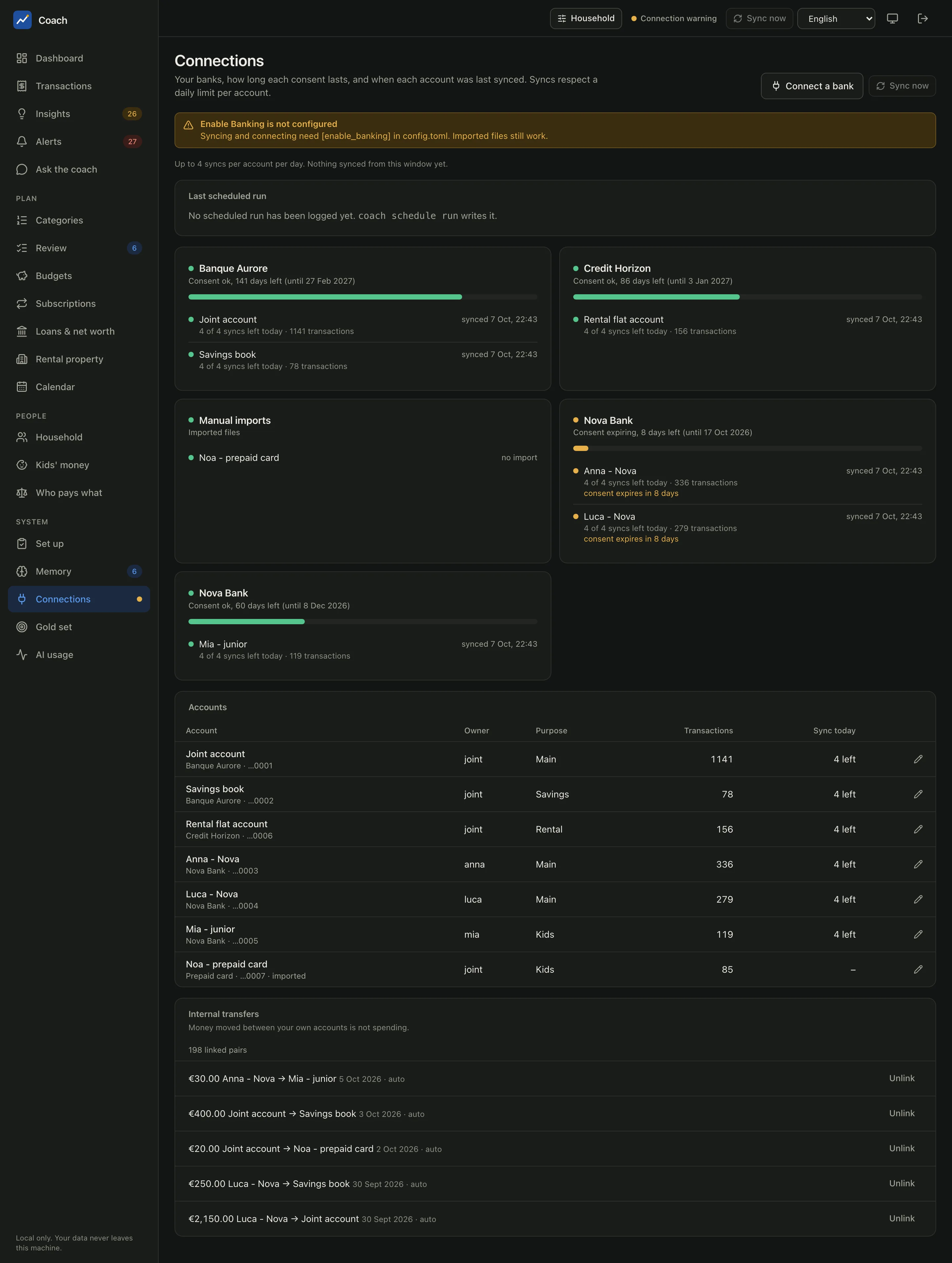
Run it every day
uv run coach schedule install --dry-run   # print the plist, the launchctl commands and any preflight problem
uv run coach schedule install             # write the LaunchAgent and load it
uv run coach schedule status              # installed? loaded? last run
uv run coach schedule uninstall
install first checks that the job can work: the database opens, db_key is in the Keychain and Enable Banking is configured in
config.toml (not in your shell environment, which launchd does not see).
The Keychain may ask once
macOS ties Keychain access to the Python binary that runs the job. After a uv Python upgrade it may prompt once (click
"Always Allow"), or the job fails until you run coach interactively and approve it.
Opt-in, because it contacts Enable Banking and your model backend every day. The time is the container's (usually UTC: set TZ
for local time).
[schedule]
time = "07:30"          # HH:MM, local time
memory_check = true     # end with a warn-only `coach memory check`
analytics = true        # warn-only analytics refresh and a net-worth snapshot
eval = true             # once a week, a warn-only OFFLINE score of the gold set (no model is called)
What a run does
flowchart LR
  A[Sync banks] --> B[Normalize]
  B --> C[Internal transfers]
  C --> D[Classify new merchants]
  D --> E[Memory check]
  E --> F[Analytics + net worth]
  F --> G[Alerts + weekly summary]
G --> H[Weekly: security audit, offline eval]| Step | What happens |
|---|---|
| sync | every connected account, within the daily PSD2 limit ([sync] daily_limit); consent warnings |
| normalize, transfers | parse the descriptions; propose (or, with [transfers] auto_link, link) internal transfers |
| classify | label new merchants: rules and memory first, then near-duplicates, then the model for the rest |
| memory check | warn-only; never fails the job |
| analytics, net worth | recurring series, anomalies, budget status; a net-worth snapshot |
| alerts | evaluate, keep, send to enabled channels; the weekly summary on its day |
| security, eval | once a week, warn-only: coach security audit and the offline gold-set score |
| coach digests | only with [coach] schedule_weekly / schedule_monthly (off by default), skipped when nothing is new |
| journal clean-up | egress journal rows older than [privacy] egress_journal_days are deleted |
The job exits non-zero when an account sync fails. Under [privacy] offline it skips the sync; a classify step refused by your privacy
settings is "skipped", not "failed".
Logs
uv run coach logs                 # one line per run: id, start, outcome, duration, failed / warned steps
uv run coach logs --tail 20       # the last 20 events
uv run coach logs --run <id>      # every event of one run
Each run writes JSON lines to <data_dir>/logs/runs.jsonl, plus a one-line summary to schedule.log. A line holds a run id, a step name,
a status, a duration and counts: never a description, a name, an amount or an exception text.
[logs]
max_kb = 512          # rotate a log at this size (name.1, name.2 ...)
keep = 5              # rotated files kept per log
max_age_days = 90     # older rotated files are deleted at the start of a run
Backups
uv run coach backup                         # an encrypted archive in [backup] dir; keeps the newest N
uv run coach restore FILE --to DIR          # restore into DIR only; never overwrites a file without --force
- An archive holds the database and
memory/, encrypted with AES-256-GCM. The key is derived from thebackup_keysecret. - The database is copied safely even while a sync runs; the archive is decrypted and checked before old ones are pruned.
restorewrites only into the--tofolder. Moving files back intodata/andmemory/is a manual step, on purpose.- The restored database is still encrypted: opening it needs the
db_keythat was in use when the backup was taken.
Keep both keys
Without backup_key an archive cannot be read; without the matching db_key the restored database cannot be opened. Store both in
your password manager.
A safe playground
Restore a backup into a scratch folder and point COACH_DB, COACH_MEMORY_DIR, COACH_DATA_DIR and COACH_CONFIG_DIR at it to try
a change on realistic data without touching the real one.