AI models
Pick the model backend that matches your privacy, cost and set-up wishes: your Claude subscription, an API key, any OpenAI-compatible provider or a local Ollama.
Where a model is used, and where it is not
Numbers come from code, words come from the model. Most of the app never calls a model at all.
| Uses a model | Never uses a model |
|---|---|
the long tail of categorization: merchants that rules, your memory and near-duplicate matching could not label (coach classify run) |
bank sync, normalization, internal transfers |
the coach: Ask the coach, coach coach ask, the skills |
analytics: averages, recurring payments, price changes, anomalies |
| the opt-in digests (weekly digest, monthly review) | forecasts, budgets, net worth, loan schedules, the weekly alerts summary |
Two settings choose the backend: [llm] backend for categorization and [coach] backend for the coach. They can differ.
The four backends
Runs claude -p (Claude Code, headless) on your Claude subscription. The default.
[llm]
backend = "claude-code"
model = "sonnet"          # sonnet | haiku | opus

[coach]
backend = "claude-code"
# model = "sonnet"
max_budget_usd = 1.0      # cap per question (digests x2 / x3); 0 = no cap
- Needs the
claudecommand, logged in on this machine. - Personal, low-frequency use only. A subscription is for interactive-scale use: you asking a few questions a day, the daily categorization and an opt-in weekly digest. For automation, sharing the app or anything frequent and unattended, use an API key. Check Anthropic's current usage terms.
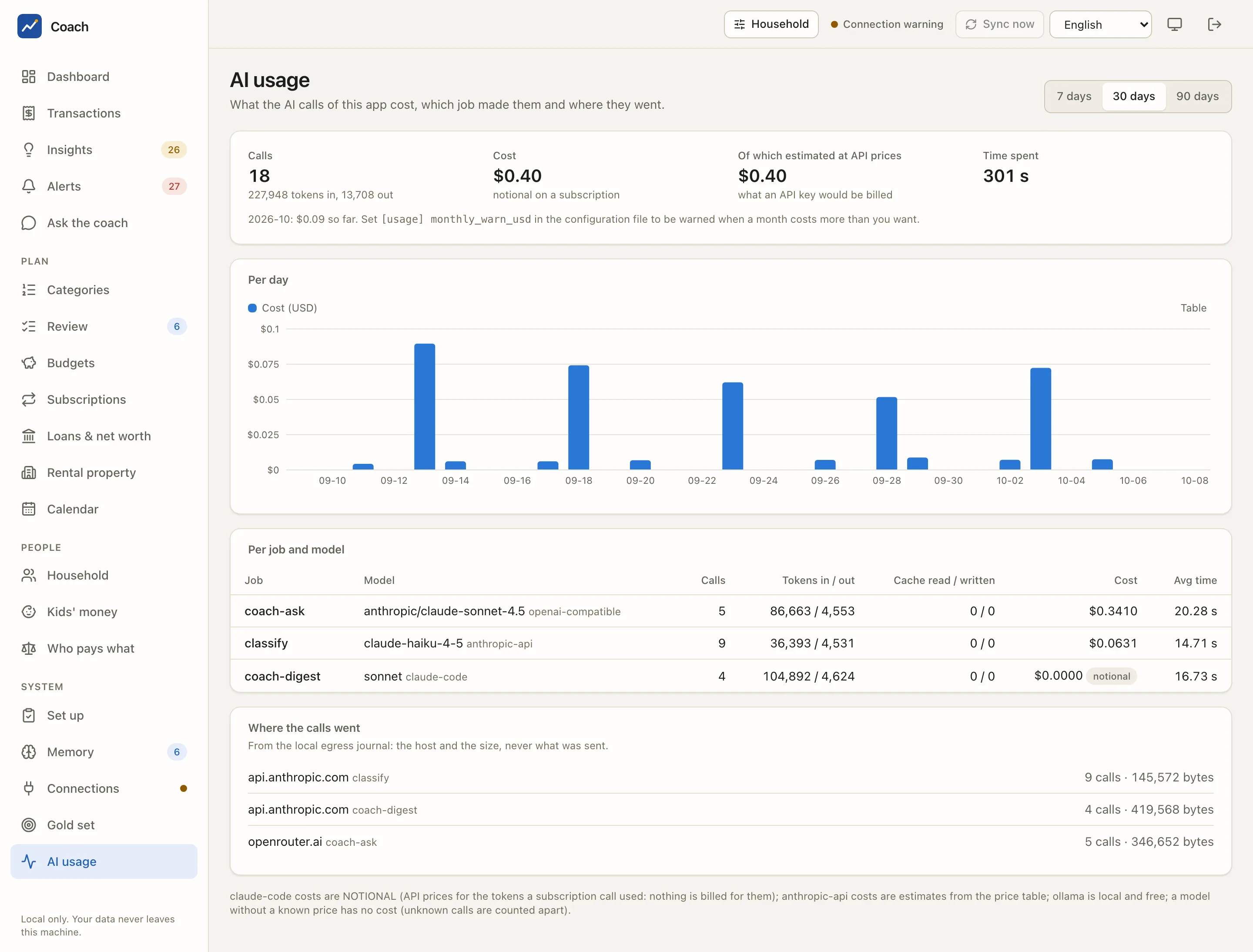
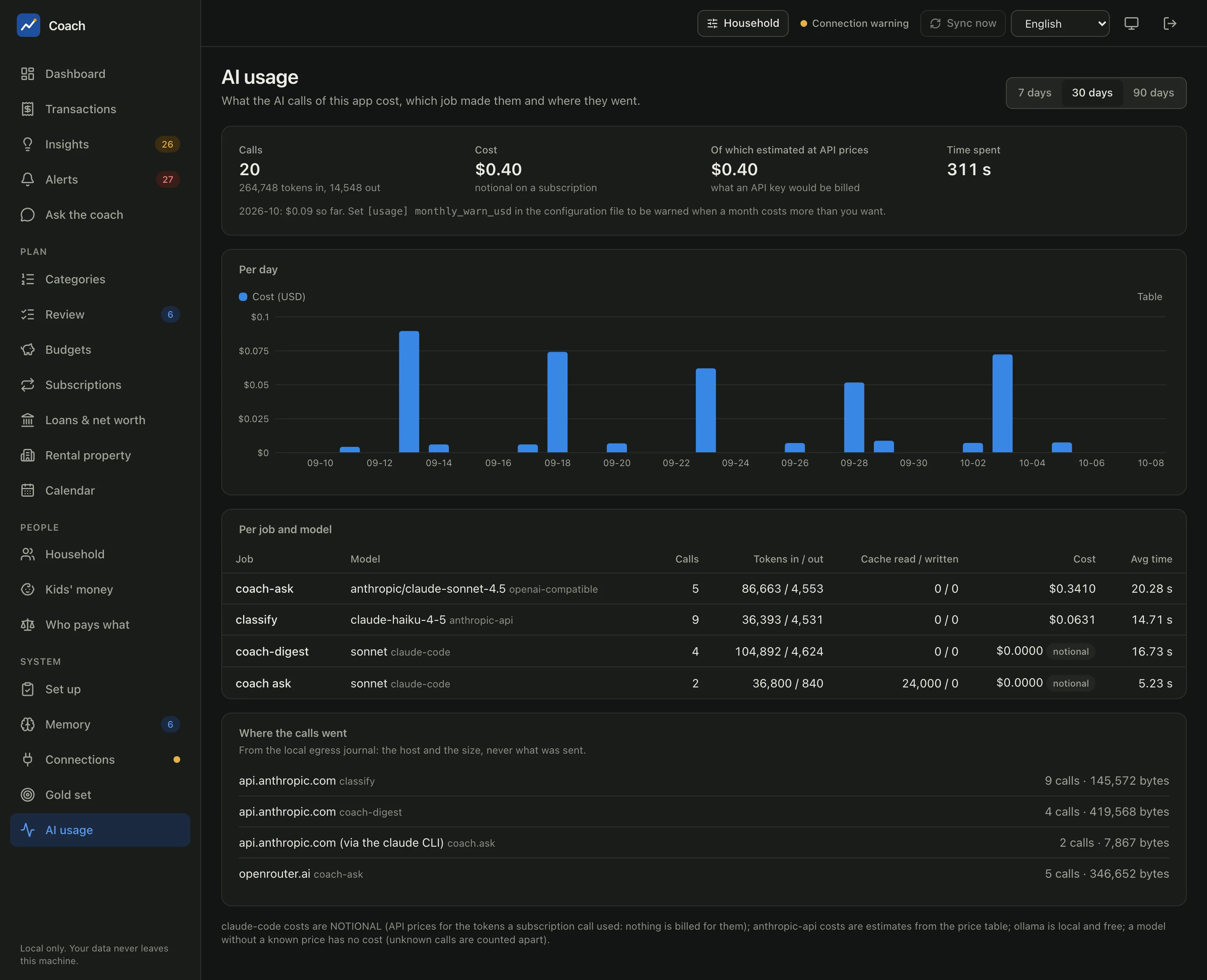
- The cost shown on AI usage is notional (API prices for the tokens used); nothing is billed per call.
clauderuns in an empty temporary folder with only the finance tools allowed and a minimal environment (no key, no proxy).
In Docker: build the CLI into the image with docker compose build --build-arg WITH_CLAUDE_CODE=1 (pinned version, checked
against a pinned hash). On your computer run claude setup-token, save the token in secrets/claude_code_oauth_token (chmod 600)
and list it in a docker-compose.override.yml. Details: Docker.
The Anthropic SDK with your API key: per-token billing, for automation or sharing.
[llm]
backend = "anthropic-api"
anthropic_model = "claude-haiku-4-5"   # aliases haiku | sonnet | opus also accepted
batch_api = false                       # true = one Message Batches request per run (50 % cheaper, async)

[coach]
backend = "anthropic-api"
# model = "claude-sonnet-5-5"           # the default for this backend
- Always talks to
https://api.anthropic.com(ANTHROPIC_BASE_URLis ignored;[llm] anthropic_base_urloverrides it). - Prompt caching on the static prompt and the tool definitions; the cost on AI usage is an estimate from the price table.
- With
batch_api = truea timed-out run resumes the same batch next time: nothing is paid twice.
Any OpenAI-style /chat/completions API: OpenRouter, Eden AI, a self-hosted vLLM ... The key is the secret openai_api_key
(environment COACH_OPENAI_API_KEY, deliberately not OPENAI_API_KEY, so an unrelated OpenAI key is never sent to another provider).
OpenRouter
[llm]
backend = "openai-compatible"
openai_base_url = "https://openrouter.ai/api/v1"     # the default
openai_model = "anthropic/claude-haiku-4.5"         # the PROVIDER's model id (required)
openrouter_deny_data_collection = true              # only providers that do not store or train on prompts (default)

[coach]
backend = "openai-compatible"
model = "anthropic/claude-sonnet-4.5"               # a model with tool calling
Eden AI
[llm]
backend = "openai-compatible"
openai_base_url = "<Eden AI's OpenAI-compatible base URL>"   # copy it from Eden AI's "OpenAI compatible" docs
openai_model = "<a model id from Eden AI>"

[coach]
backend = "openai-compatible"
# model = "<a model id with tool calling>"           # default: [llm] openai_model
openai_base_url is the part before /chat/completions. Copy it, and the model ids, from Eden AI's "OpenAI compatible"
documentation: this project does not ship a URL for it.
- The base URL must be
https(orhttpon this machine only). - The cost is logged only when the provider reports it (OpenRouter does); it is never guessed.
- Structured output uses the JSON schema, with a JSON-mode fallback for models without it.
A model on your own machine: free, and nothing leaves it.
[llm]
backend = "ollama"
ollama_url = "http://localhost:11434"
ollama_model = "llama3.1"       # must support the JSON-schema `format`
ollama_allow_remote = false     # the server must be on loopback unless true

[coach]
backend = "ollama"              # a model that supports tool calling, or the coach refuses
- Prompts contain (redacted) bank data, so a non-loopback
ollama_urlis refused unlessollama_allow_remote = true, and always refused under[privacy] local_only. - Small local models classify and explain less well than a cloud model. Answers are not streamed token by token.
The coach needs tool calling
The coach reads your data only through the finance tools, so its model must support tool calling. With ollama or
openai-compatible a model without it is refused with a clear message. Categorization does not need tools.
Compare
| claude-code | anthropic-api | openai-compatible | ollama | |
|---|---|---|---|---|
| Where data goes | Anthropic, through claude |
api.anthropic.com |
the provider you set | this machine |
| Cost | your subscription (cost shown is notional) | per token, estimated | per token, when the provider reports it | free |
| Set-up | claude logged in |
API key | API key + base URL + model id | an Ollama server + a model |
| Use | personal, low frequency | automation, sharing | when you have no Anthropic key | full privacy (local_only) |
| Works in Docker | opt-in build arg + token | yes | yes | yes (ollama_allow_remote for a host server) |
Every backend gets the same redacted input: IBANs, e-mails, phone numbers, long digit runs and your household's names are removed, and anything that looks like a person is never sent. See Privacy modes.
Coach limits
| Key | Default | Meaning |
|---|---|---|
[coach] max_tool_calls |
12 |
tool calls per question (digests get twice as many) |
[coach] max_tokens |
4096 |
per model answer (API, ollama, openai-compatible) |
[coach] timeout_seconds |
180 |
per question (digests: three times) |
[coach] schedule_weekly / schedule_monthly |
false |
opt-in digests written by the daily job |
[coach] allowed_builtin_agents, allowed_plugins, allow_builtin_plugins |
see template | what the claude start-up event may list; anything else aborts the run |
[coach] claude_env |
[] |
extra environment variable names passed to claude (never a secret) |
[coach] claude_restricted |
false |
also pass --restricted to claude -p (not verified with a subscription login) |
See what would be sent, then send
uv run coach classify run --dry-run              # the exact redacted requests (items, examples, hints); nothing is called
uv run coach coach digest --weekly --dry-run     # the exact prompts and redacted tool outputs; no model is called
uv run coach coach ask --skill monthly-review --dry-run
During first-run set-up (coach setup) the categorization step shows this dry run first, then asks you to choose: run it with the
current backend, go fully local, or skip. Running it needs you to type send; nothing leaves the machine before.
Review the dry run before the first run on a new bank
Person detection is a heuristic. A family-named company can be held back, a shop named after its owner can pass. The dry run shows
exactly what would go out; coach classify review lists what was held back.
Costs and the AI usage page
Every call writes one row with backend, model, tokens, cost estimate, duration and purpose. See it with coach usage or on
AI usage in the web app (7, 30 or 90 days). Set [usage] monthly_warn_usd to get a local alert when a month costs more than you want.