Privacy modes
The [privacy] section decides what a model may see and whether anything may leave your machine at all, and the egress journal shows what did.
The settings
[privacy]
model_detail = "coarse"       # what a model is told: coarse (default) | standard
local_only = false            # true = every model is Ollama on this machine; no web search; no external alert channel
offline = false               # true = nothing leaves this machine (implies local_only); no bank sync
web_enrich = false            # opt-in: `classify enrich` searches the web with redacted shop names
egress_journal = true         # log every outbound call (host, size, purpose; never a payload)
egress_journal_days = 365     # the daily job deletes older journal rows (30 to 3650)
These are your decisions: the app, the web pages and the coach never change them.
What a model sees: model_detail
Whatever the mode, names, accounts and keys are always pseudonymised: accounts become account-main-1, people adult-1 or kid-1, transactions hashed refs like h_0123456789.
coarse (default) |
standard |
|
|---|---|---|
| Salary payer | [employer] |
[employer] (declared and derived employers are always masked) |
| School payees | [school] |
declared schools scrubbed |
| Small or person-like merchants | [merchant:<category>]-<hash> |
merchant titles kept, except what the person guard flags |
| Towns in merchant titles | cut | declared and derived towns masked ([place]) |
| Banks, lenders, insurers in memory | by what they are (regional bank, car-lease company) |
real names |
| Free text of memory (profile, preferences, notes) | withheld | shown, with names scrubbed |
Choose standard if you want the coach to follow the tone and language rules of your preferences.md.
Redaction examples (demo household)
| In your data | What a model sees |
|---|---|
| the joint account at Banque Aurore | account-main-1 |
| Anna, Mia | adult-1, kid-1 |
| a card payment at Fresh Market | the payment's date, signed amount, category and h_0123456789 |
| a small local shop named after its owner | [merchant:food]-<hash> (coarse) |
| Luca's salary | income from [employer] |
| a merchant name that reads like an instruction | {"untrusted_text": "..."}, flagged as suspicious |
A final check on every tool output refuses the whole result if a member name, an account label, an IBAN, an e-mail or a path slips through. It fails closed.
Fully local: local_only
[privacy]
local_only = true
[llm]
backend = "ollama"
[coach]
backend = "ollama"        # a model with tool calling
Under local_only:
- every model is Ollama on this machine (loopback); a cloud backend is refused, even a remote Ollama with
ollama_allow_remote; classify enrichand the web-search skills (find-cheaper,mortgage-check) refuse;- ntfy, e-mail and Telegram alerts are "not ready"; the macOS notification stays (nothing leaves);
coach mcp serverefuses, because its client would be a cloud model;- Enable Banking stays allowed: it is your data source.
offline = true goes further: the bank sync is refused too, and you import bank files with coach import. Expect lower quality from
small local models.
Web enrichment: web_enrich
coach classify enrich is the one path where a model searches the web with something derived from your transactions. It is off unless you
set web_enrich = true, it only searches shops (never anything that could be a person), strips towns and redacts every descriptor. The
Ask AI button of the web app's review queue uses the same path for one merchant when it is on (and the classifier without the web when
it is off).
uv run coach classify enrich --dry-run # the exact request; works even when enrichment is off; sends nothing
The egress journal
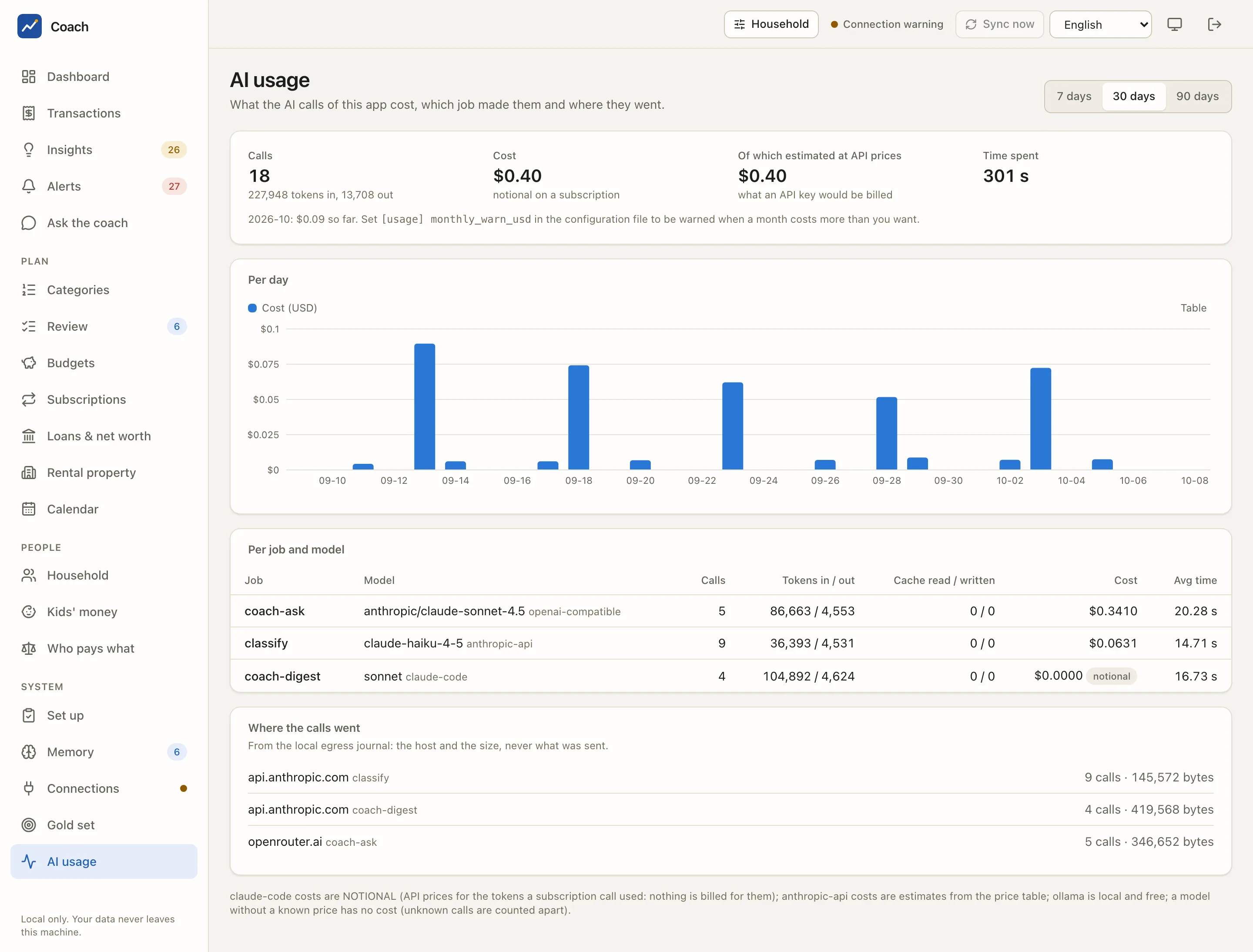
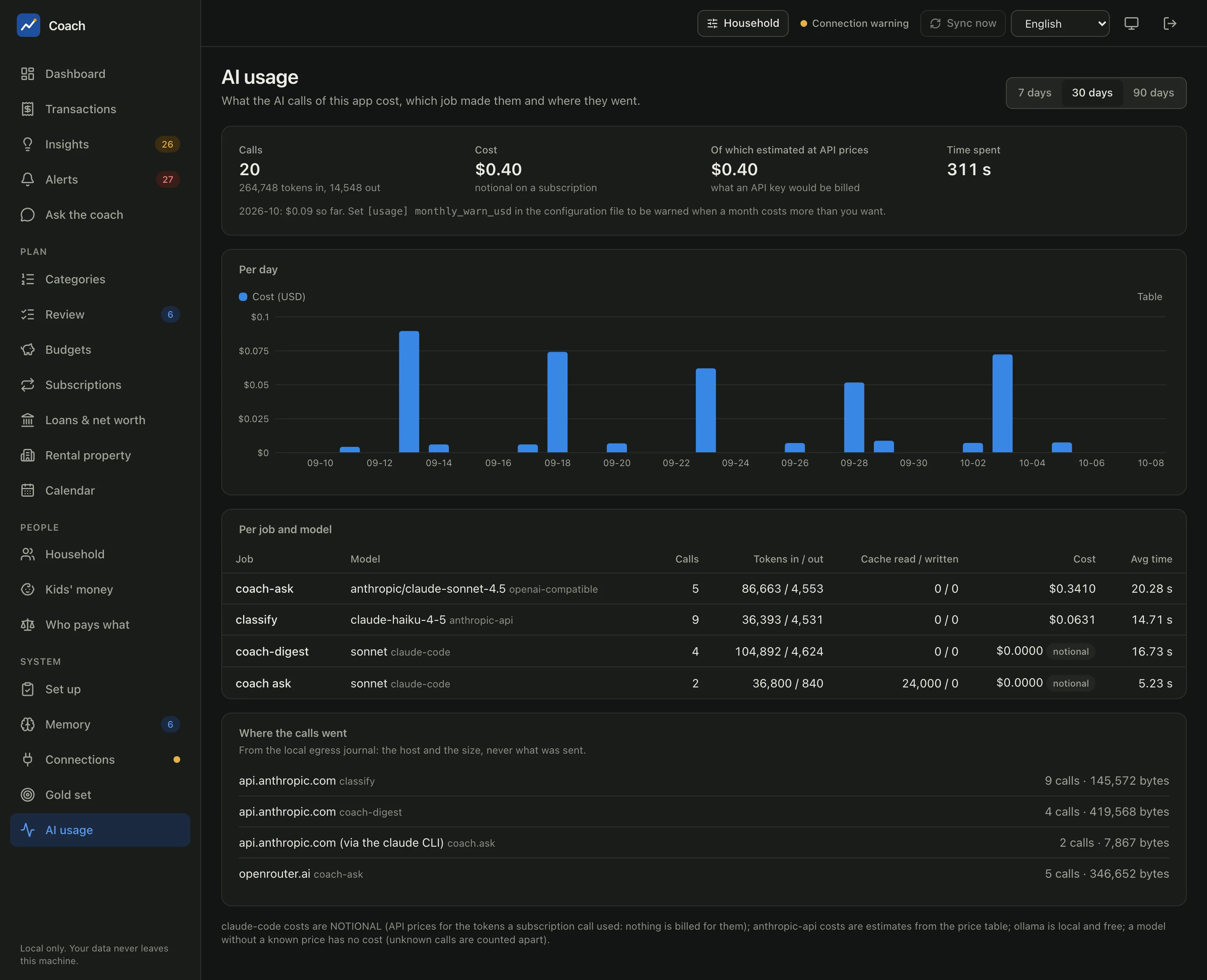
Every outbound call goes through one gate that applies the settings above and writes one row to a local journal: time, kind, destination host, size, purpose, redaction mode, allowed or denied. Never a payload, a URL path, a name, an amount or a token.
uv run coach privacy status         # the effective mode and what each outbound path may do (--json for scripts)
uv run coach privacy report         # every outbound path + the last 30 days of the journal
| Outbound path | Where to | What is sent |
|---|---|---|
| Enable Banking | api.enablebanking.com |
ids and date ranges; bank data comes back, nothing of yours goes out |
| a model backend | Anthropic, your provider, or Ollama | redacted merchant descriptors, or the coach's question and redacted tool results |
| the finance MCP server | the model behind Claude Code | redacted, pseudonymised tool results |
| alert channels | your ntfy, SMTP or Telegram | a minimal message (see Alerts & channels) |
| web search skills | the search engine of Claude Code | generic, non-personal queries |
What is stored where
| Data | Where | How long |
|---|---|---|
| transactions, accounts, labels, insights, alerts, net worth | the encrypted database (SQLCipher) | until you delete them |
| household memory, its history and proposals | memory/, owner-only files |
until you delete them |
| AI usage (model, tokens, cost; no content) | database | kept |
| egress journal | database | egress_journal_days (365) |
| encrypted backups | backups/ |
the newest [backup] retention (14) |
| logs | data/logs/ |
rotated by [logs] |
| secrets | Keychain or the secrets folder | until you delete them |
What a provider keeps of what it receives is governed by its own terms.
Export and delete
coach export writes an encrypted archive of all your data (readable with backup_key). coach wipe deletes the database, memory,
data folder and, if you say so, the backups and the secrets.
Both are for you, at a terminal
coach wipe --dry-run lists what would be deleted and touches nothing. The real coach wipe asks for a typed phrase on a terminal,
has no --yes, and first writes an encrypted export. Exporting in clear also needs a terminal and a typed phrase. Never let an agent run
either; the permission template denies them.
See also
- Privacy reference: the full inventory, retention and export format
- Security: the threat model and residual risks
- The coach (LLM): privacy model