Alerts & channels
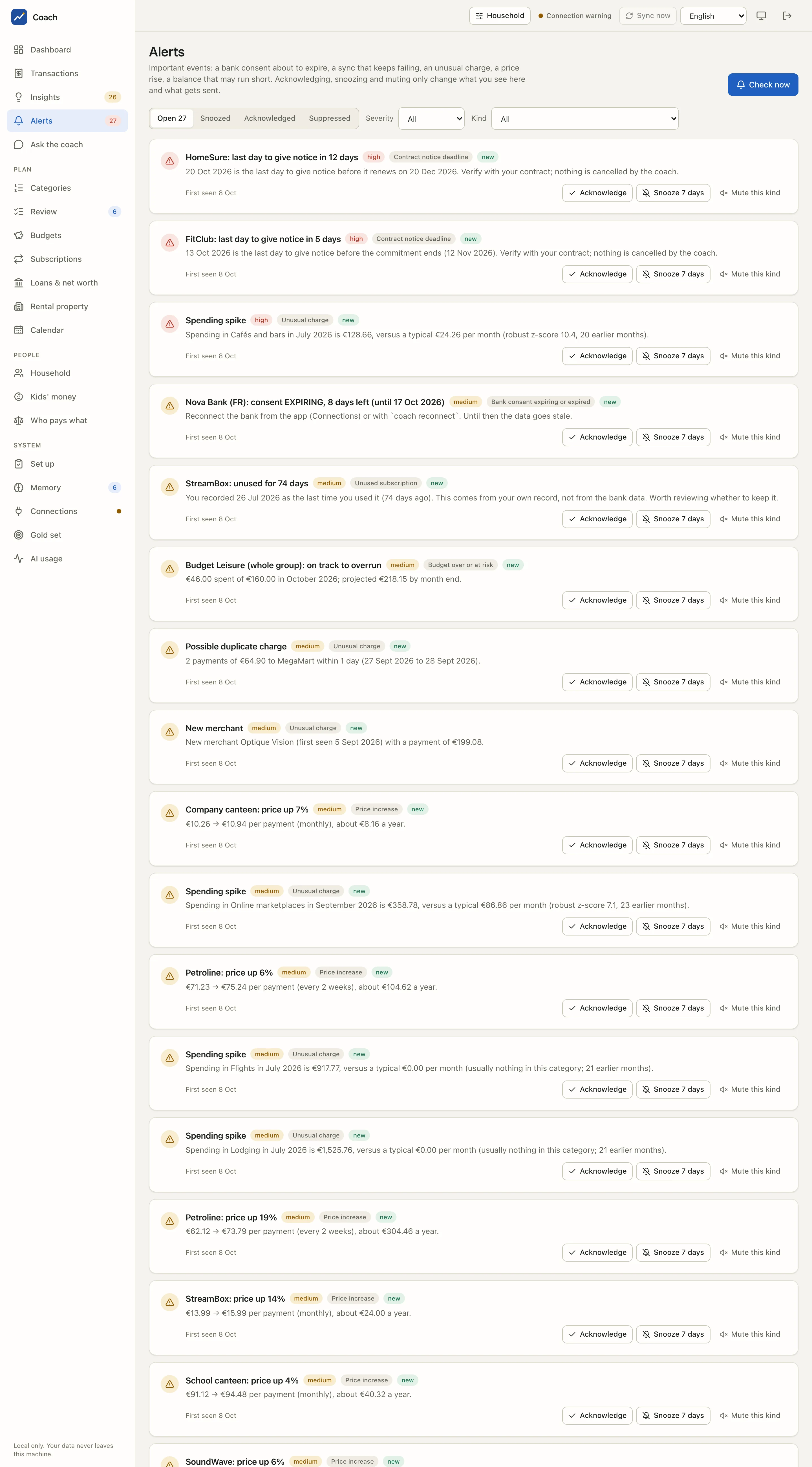
Alerts always appear in the app; you choose whether ntfy, e-mail, Telegram or a macOS notification also gets a short, privacy-safe message.
How it works
The daily job (and coach alerts check) turns signals the app already computes into alerts: a consent about to expire, a sync that
keeps failing, an unusual charge, a price rise, a balance that may run short, a budget over, a loan payment missed, a notice deadline, a
service you cancelled that is still charged. Numbers come from code, never from a model.
- The in-app feed is always on: the Alerts page, the dashboard card and the badge in the menu.
- Channels are all off until you enable them in
config.toml. The app, the API and the coach never turn one on. - One situation is one alert. It is sent to a channel once, and again only when its severity goes up.
Noise control
[alerts]
enabled = true                       # evaluate signals and keep the events (the in-app feed)
min_severity = "low"                 # low | medium | high: below it, kept but never sent outside the app
external_min_severity = "medium"     # nothing below it is sent by any channel
external_detail = "minimal"          # minimal | summary (see below)
quiet_hours = "22:00-08:00"          # local time; held alerts go out after it ("" = off)
max_per_week = 7                     # messages per channel in a rolling 7 days; 0 = nothing outside the app
disabled_kinds = []                  # kinds not evaluated at all
digest_only_kinds = ["price_increase", "unusual_charge"]   # in the app and the weekly summary, never sent one by one

[alerts.thresholds]
sync_failures = 3                    # failed syncs in a row before an alert (high at twice that)
anomaly_min_severity = "medium"      # unusual-charge alerts: medium | high
Kinds you can list: consent, sync_failing, unusual_charge, price_increase, low_balance, budget, loan_alert, loa_end,
unused_subscription, contract_notice, decision_contradicted, scheme_end, scheme_check, rent_missing.
Quiet hours hold everything
Quiet hours and the weekly budget also hold back a high alert; there is no bypass. The in-app feed is never held.
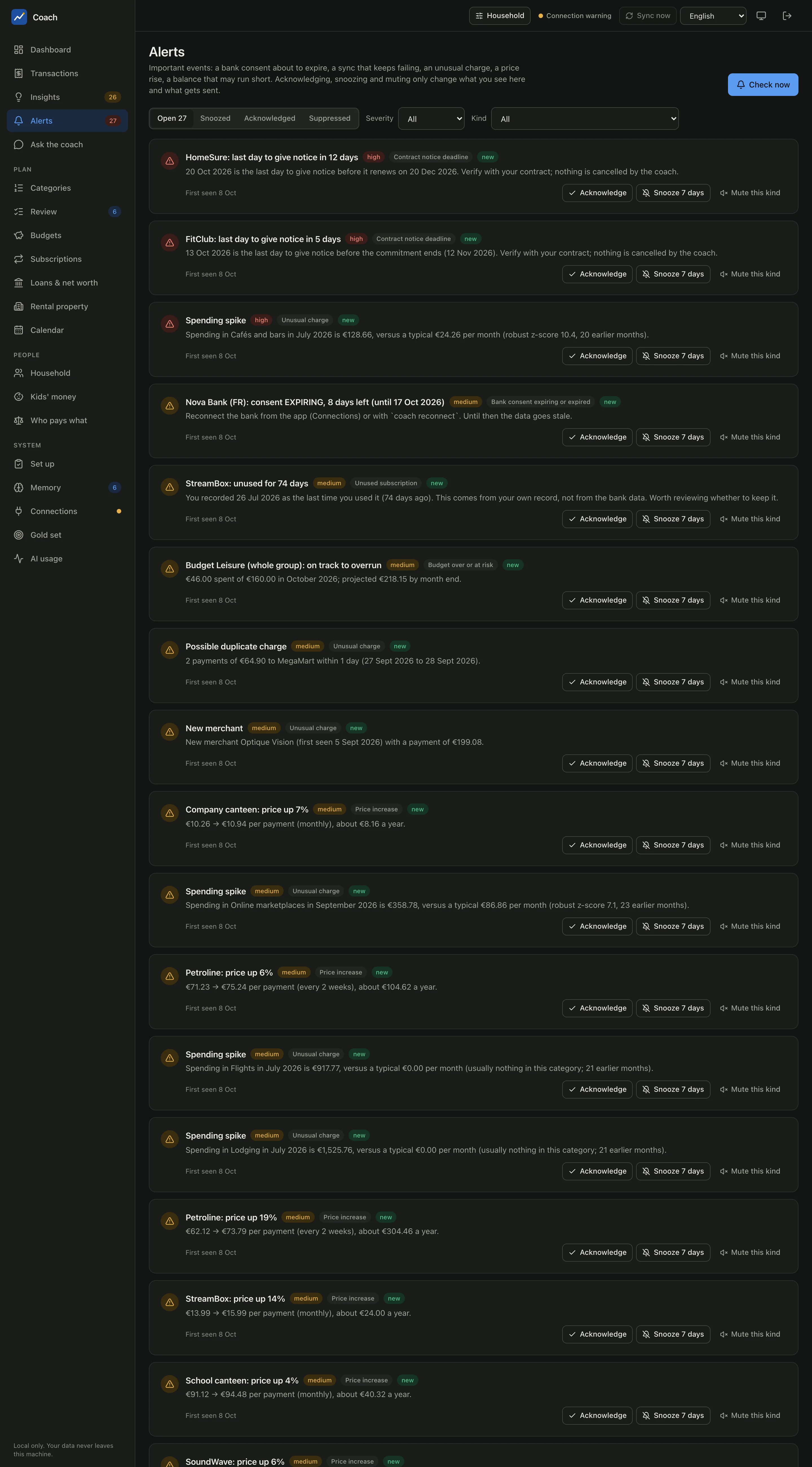
Acknowledge, snooze and mute from the Alerts page (Acknowledge, Snooze 7 days, Mute this kind) or with coach alerts ack|snooze|mute-kind.
That state lives in the database, not in the config.
Channels
Store each secret with coach config set-secret, never in the file. A channel that is enabled but misses a field or a secret is reported by
coach alerts channels and skipped; it never stops the daily job.
[alerts.ntfy]
enabled = true
url = "https://ntfy.sh/<long-random-topic>"    # https only; or your own server
On public ntfy.sh the topic name is the only secret: make it long and random, or use a self-hosted server with a token.
What a message says: external_detail
ntfy, e-mail and Telegram are third-party transports. Their messages are built from a fixed vocabulary and numbers, never from the alert's own
text, and pass the same privacy guard as the finance tools. The title is always Coach alerts.
Never, in either mode: a merchant, account, bank, person, employer, town, IBAN, e-mail, phone, address, contract number or balance. A
summary the guard refuses goes out as minimal. Children's budget alerts (kid_budget) and the AI-cost alert never leave the app, not even
as a count. [privacy] local_only turns ntfy, e-mail and Telegram off.
The weekly summary
weekly_digest = true                 # build it once a week into the in-app feed (deterministic, local)
weekly_digest_day = "mon"            # mon .. sun
weekly_digest_to_channels = false    # also send a teaser: "Coach: your weekly summary is ready. Open the app."
app_url = ""                         # optional link added to external messages
It compares last week's variable spending with a usual week, lists the next 7 days of payments and deadlines, the open alerts, budgets at risk and the savings tracker. A channel only ever gets the teaser, never the summary.
Test without sending
uv run coach alerts channels                          # what is enabled and ready (secrets never printed)
uv run coach alerts test-channel ntfy --dry-run       # the exact test message, tokens masked; sends nothing
uv run coach alerts check --dry-run                   # what each channel would get for today's real alerts
uv run coach alerts digest --dry-run                  # preview the weekly summary
The Test (dry run) buttons in the Channels panel of the Alerts page do the same. A real test (test-channel without --dry-run) needs
an interactive terminal and a typed yes; run it yourself, once, to check the transport works.
See also
- Insights & alerts in the guide
- Alerts reference: every kind, dedupe and escalation rules
- Privacy modes