Configuration
One commented TOML file, config.toml, holds every setting of the coach; secrets never go in it.
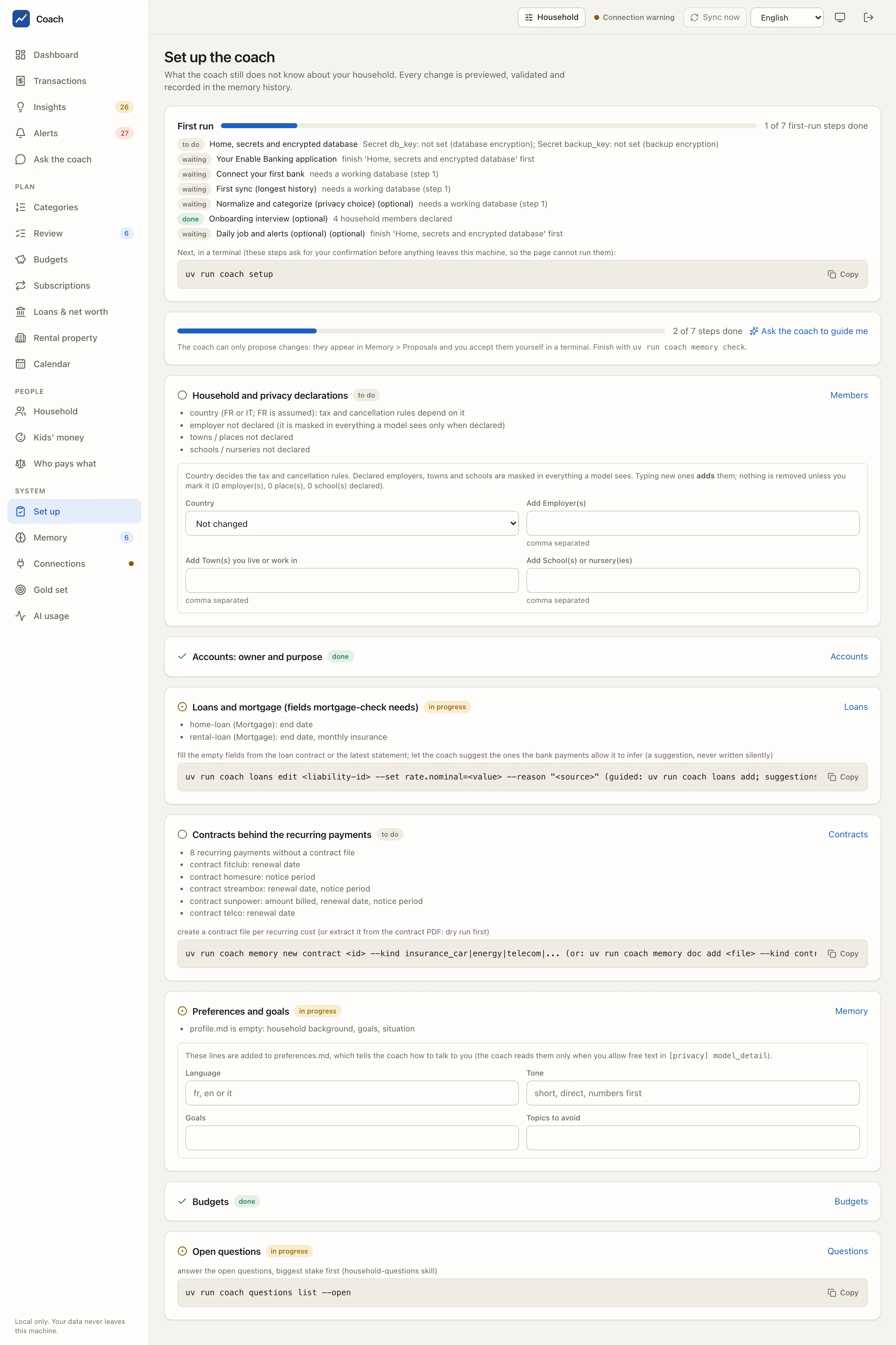
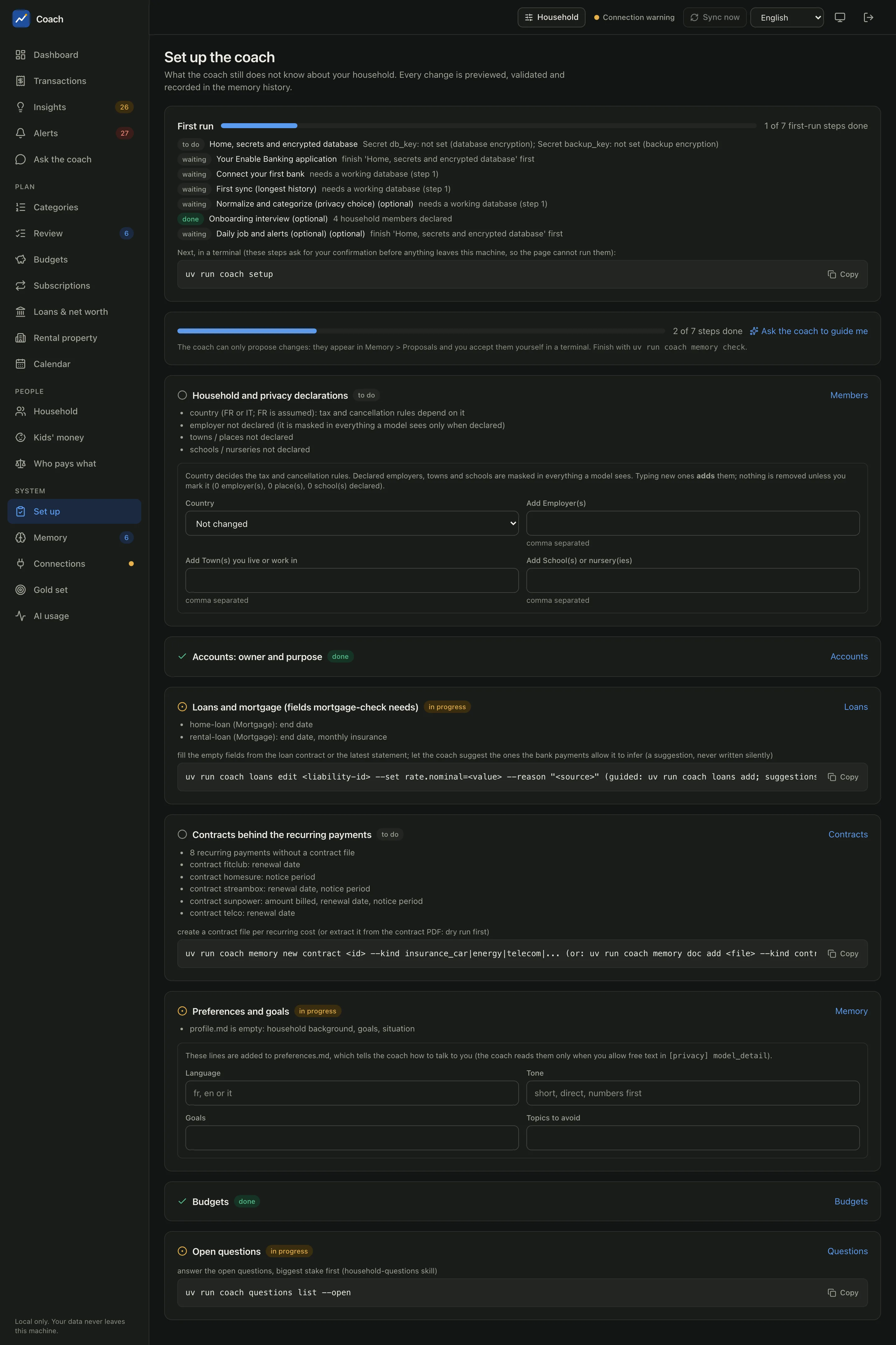
config.toml.How it works
coach init writes config.toml for you from the commented template config.example.toml. You can also copy the template by hand
and edit it. Every key is optional: a key you leave out takes its default.
Where the file is found, in this order:
--config PATHon the command line, or theCOACH_CONFIGenvironment variable (the file's folder becomes the project root);COACH_HOME: the folder that holdsconfig.toml;- the current folder or its nearest parent that holds a
config.toml(orconfig.example.toml, as in a checkout); - for an installed package (
uvx,pipx):~/.ai-finance-coach.
In Docker the file is coach-home/config/config.toml on the host (/config/config.toml in the container).
Precedence: environment variable > config.toml > built-in default. Relative paths (data_dir, memory_dir, [backup] dir ...)
are resolved against the folder that holds config.toml.
A wrong value (a typo in a key, an http:// alert URL, an unknown alert kind) stops the configuration from loading with a clear message.
Secrets never go in the file
Keys and passwords live in a secret store, never in config.toml. Why: the config file is plain text you edit, copy and share when you
ask for help; a key in it would travel with it.
| Store | When | How |
|---|---|---|
| macOS Keychain (default) | on a Mac | service ai-finance-coach, one item per secret |
| a folder of files | Docker, a Linux server | COACH_SECRETS_BACKEND=file and COACH_SECRETS_DIR (default /run/secrets): one file per secret, named like it, holding only the value, mode 0600 |
uv run coach config set-secret db_key --generate      # create a random key in the active store
uv run coach config set-secret smtp_password          # type a value (it is never echoed or printed)
A secret is looked up as: environment variable, then the store, then a clear error. coach config show and coach doctor only say whether a
secret is set and where it comes from.
| Secret | Environment variable | Needed for |
|---|---|---|
db_key |
COACH_DB_KEY |
the encrypted database (SQLCipher). Required |
backup_key |
COACH_BACKUP_KEY |
encrypted backups and exports |
proposal_key |
COACH_PROPOSAL_KEY |
sealing memory proposals against tampering (optional, recommended) |
anthropic_api_key |
ANTHROPIC_API_KEY |
the anthropic-api backend |
openai_api_key |
COACH_OPENAI_API_KEY |
the openai-compatible backend (deliberately not OPENAI_API_KEY) |
claude_code_oauth_token |
CLAUDE_CODE_OAUTH_TOKEN |
the claude-code backend in a container |
ntfy_token, smtp_password, telegram_bot_token |
COACH_NTFY_TOKEN, COACH_SMTP_PASSWORD, COACH_TELEGRAM_BOT_TOKEN |
alert channels |
sso_client_secret |
COACH_SSO_CLIENT_SECRET |
web app SSO through an authentik proxy provider ([ui] sso_signing = "client_secret") |
Keep a copy of db_key and backup_key
Save both in your password manager. Losing db_key makes the database unrecoverable; losing backup_key makes the backups unreadable.
Environment variables
| Variable | Effect |
|---|---|
COACH_HOME |
the project root (the folder of config.toml, data and memory) |
COACH_CONFIG |
the path of config.toml (same as --config) |
COACH_DB |
the database file (overrides db_path) |
COACH_DATA_DIR, COACH_MEMORY_DIR |
override data_dir and memory_dir |
COACH_CONFIG_DIR |
where your editable copies of taxonomy.yaml / rules.yaml live (default config/ next to config.toml) |
COACH_SECRETS_BACKEND, COACH_SECRETS_DIR |
the secret store: keychain (default) or file, and the folder of the file store |
COACH_SECRETS_ALLOW_READABLE |
1 accepts secret files readable (never writable) by others, for swarm or Kubernetes mounts |
EB_APP_ID, EB_REDIRECT_URL, EB_PRIVATE_KEY_PATH, EB_API_URL |
override the [enable_banking] values |
| the secret variables above | override the secret store |
Try things on a scratch copy
Point COACH_DB, COACH_MEMORY_DIR, COACH_DATA_DIR and COACH_CONFIG_DIR at a restored backup (coach restore FILE --to DIR) to test a
setting without touching your real data.
Section by section
The reference below follows config.example.toml. Topics with their own page: AI models ([llm], [coach]),
Privacy modes ([privacy]), Alerts & channels ([alerts]), Daily job & backups ([schedule],
[backup], [logs]) and Remote access ([ui]).
Top level
| Key | Default | Meaning |
|---|---|---|
data_dir |
"data" |
database, logs, TLS certificate, web-app state |
memory_dir |
"memory" |
the household memory (categorization.yaml, profile.md ...) |
db_path |
<data_dir>/finance.db |
the database file |
insecure_plaintext_db |
false |
true allows an unencrypted database (same as --insecure); leave it off |
[db], [enable_banking], [sync], [callback]
| Key | Default | Meaning |
|---|---|---|
db.auto_migrate |
true |
any command applies pending migrations (with a notice); false = only coach db migrate does, others refuse |
enable_banking.app_id |
"" |
your application id from the Enable Banking control panel |
enable_banking.redirect_url |
"" |
must be whitelisted in your Enable Banking app (usually https://localhost:8443/callback) |
enable_banking.private_key_path |
"" |
the .pem you downloaded; keep it outside the project folder |
enable_banking.api_url |
https://api.enablebanking.com |
commented out; rarely changed |
sync.daily_limit |
4 |
unattended syncs per account per day (PSD2 cap) |
callback.timeout_seconds |
600 |
how long coach connect / reconnect wait for the bank redirect |
callback.container_bind |
false |
written true only by the Docker image's coach init; never set it on a host |
[llm] and [coach]
The backend for categorization ([llm]) and for the coach ([coach]), their models and limits. Every key is explained on
AI models.
[classify]
| Key | Default | Meaning |
|---|---|---|
knn_enabled |
true |
near-duplicates of merchants you already labelled are labelled without a model |
knn_threshold |
0.92 |
minimum similarity for such an automatic label |
knn_examples |
5 |
nearest labelled merchants sent with each item as examples |
llm_allowlist |
[] |
regexes of transfer-like merchant keys (companies without a legal form in their name) that may be sent to a model; by default anything that could be a person is held back |
[transfers]
| Key | Default | Meaning |
|---|---|---|
window_days |
3 |
the two legs of an internal transfer must be within this many days |
cross_bank_window_days |
5 |
the same when the legs are on different banks |
auto_link |
false |
true = the daily job links confident pairs itself; false = it only proposes them |
topup_merchants |
["REVOLUT", "LYDIA", "PAYPAL"] |
card payments to these may be top-ups of another own account (proposals only, never auto-linked) |
min_confidence |
0.85 |
pairs below this are never auto-linked |
[memory], [health], [import], [notify]
| Key | Default | Meaning |
|---|---|---|
memory.history |
true |
keep a change history of memory/ (needs git) |
memory.stale_months |
6 |
coach memory check reports loan / contract facts older than this |
memory.asset_stale_months |
3 |
... and asset values older than this |
memory.big_tx_threshold |
2000 |
coach questions generate: one-off payments above this (EUR) not explained by memory |
memory.question_min_stake |
300 |
merchants with less money at stake (EUR) are not asked about |
health.stale_days |
2 |
coach health: no successful sync for longer = stale |
import.profiles_dir |
"config/import_profiles" |
CSV mapping profiles for coach import |
notify.macos |
false |
a macOS notification when a consent is about to expire (superseded by [alerts.macos]) |
[analytics]
Thresholds of the deterministic analytics. Every key is optional and commented out in the template; the defaults suit most households.
All analytics keys and their defaults
| Key | Default | Meaning |
|---|---|---|
average_window_months / average_min_months |
12 / 3 |
months behind a category average; fewer = low confidence |
recurring_amount_tolerance |
0.15 |
recurring amounts within ±15 % of the median |
recurring_min_occurrences |
3 |
payments needed for a series (yearly: 2, low confidence) |
recurring_ended_factor |
1.5 |
no payment for 1.5 × the cadence = ended |
recurring_variable_categories |
energy, water, telecom | bills whose amount varies |
recurring_yearly_pair_groups |
subscriptions, insurance, housing, taxes ... | groups where two payments a year apart can form a yearly series |
price_change_threshold_pct / price_change_min_abs |
3.0 / 0.50 |
a price change is at least 3 % and 0.50 EUR |
price_change_variable_pct |
20.0 |
variable bills: only 20 % moves count |
anomaly_min_history_months |
6 |
earlier covered months needed for a category spike |
anomaly_z, anomaly_min_excess, anomaly_min_ratio |
3.5, 50.0, 1.5 |
how unusual a category month must be |
anomaly_duplicate_days / anomaly_duplicate_min_amount |
3 / 10.0 |
same merchant and amount within N days = duplicate |
anomaly_new_merchant_days / anomaly_new_merchant_min |
60 / 150.0 |
a new merchant with a payment of at least this |
anomaly_large_tx_min, anomaly_lookback_days, anomaly_months |
100.0, 90, 3 |
large payments; how far back to look |
forecast_band_z |
1.28 |
forecast band (about 80 %) |
forecast_variable_months, forecast_balance_stale_days |
6, 3 |
variable-spend estimate; stale balance flag |
budget_suggest_months, calendar_days, asset_stale_months |
6, 60, 3 |
budget suggestions, calendar window, asset reminder |
loan_grace_days, loan_reminder_months |
5, 6 |
missing loan payment; lease end reminders |
rental_reminder_months, rental_rent_grace_days, rental_rate_gap_pts |
12, 7, 0.5 |
rental scheme end, missing rent, rate gap |
[privacy], [alerts], [schedule], [backup], [logs], [ui]
See Privacy modes, Alerts & channels, Daily job & backups and Remote access.
[usage]
| Key | Default | Meaning |
|---|---|---|
monthly_warn_usd |
0 |
above 0: a local llm_usage_high alert when a month's AI cost passes it (never sent to a channel) |
include_notional |
true |
count the notional cost of subscription (claude-code) calls in that threshold |
See also
- CLI reference: Setup, Configuration, Secrets
- Docker for the container layout of the config, data and secrets
- Security for why secrets stay out of the file