The finance tools
The finance tools are the coach's only window on your data: each one returns computed, redacted figures, and only a handful can write, and then only a proposal.
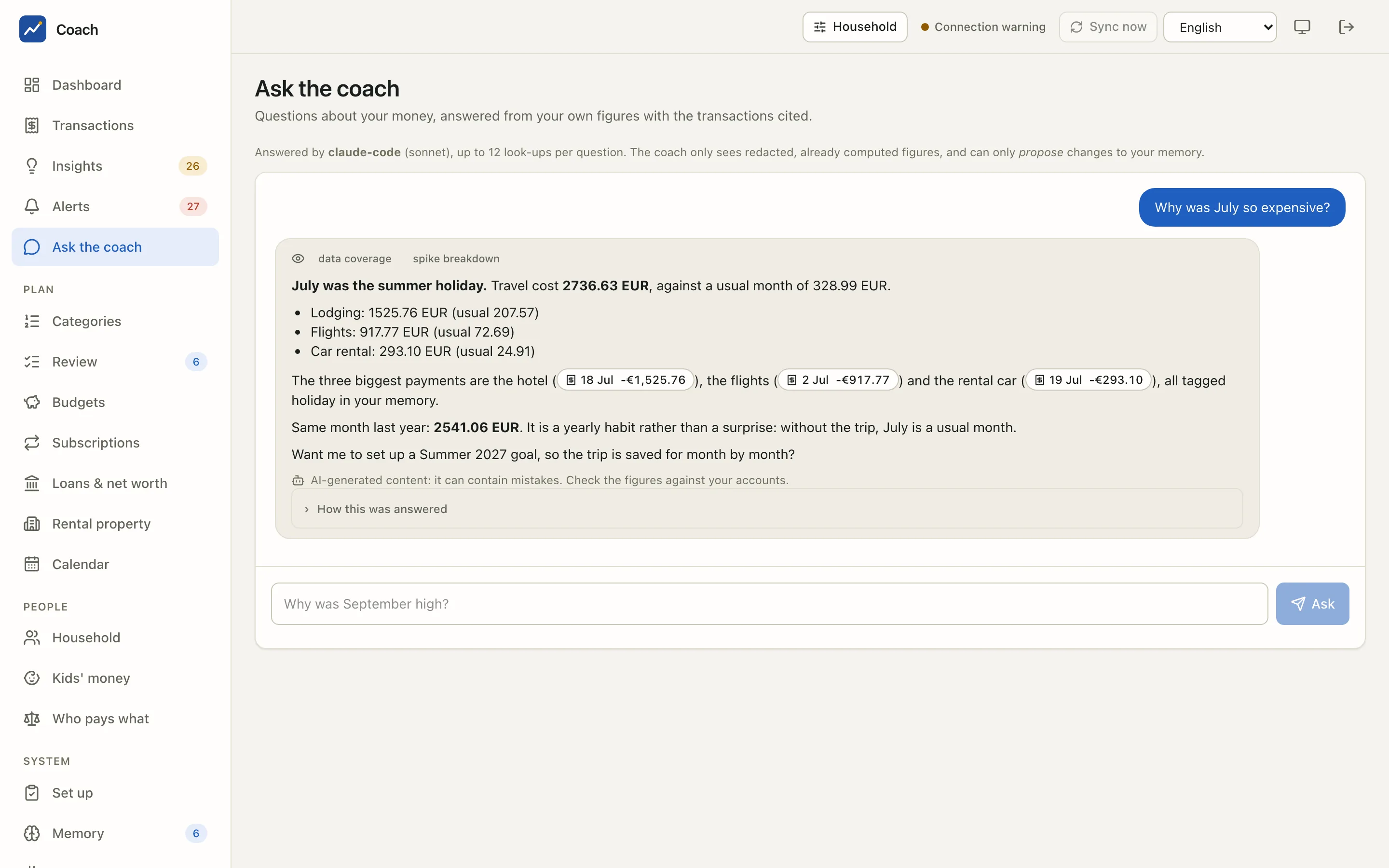
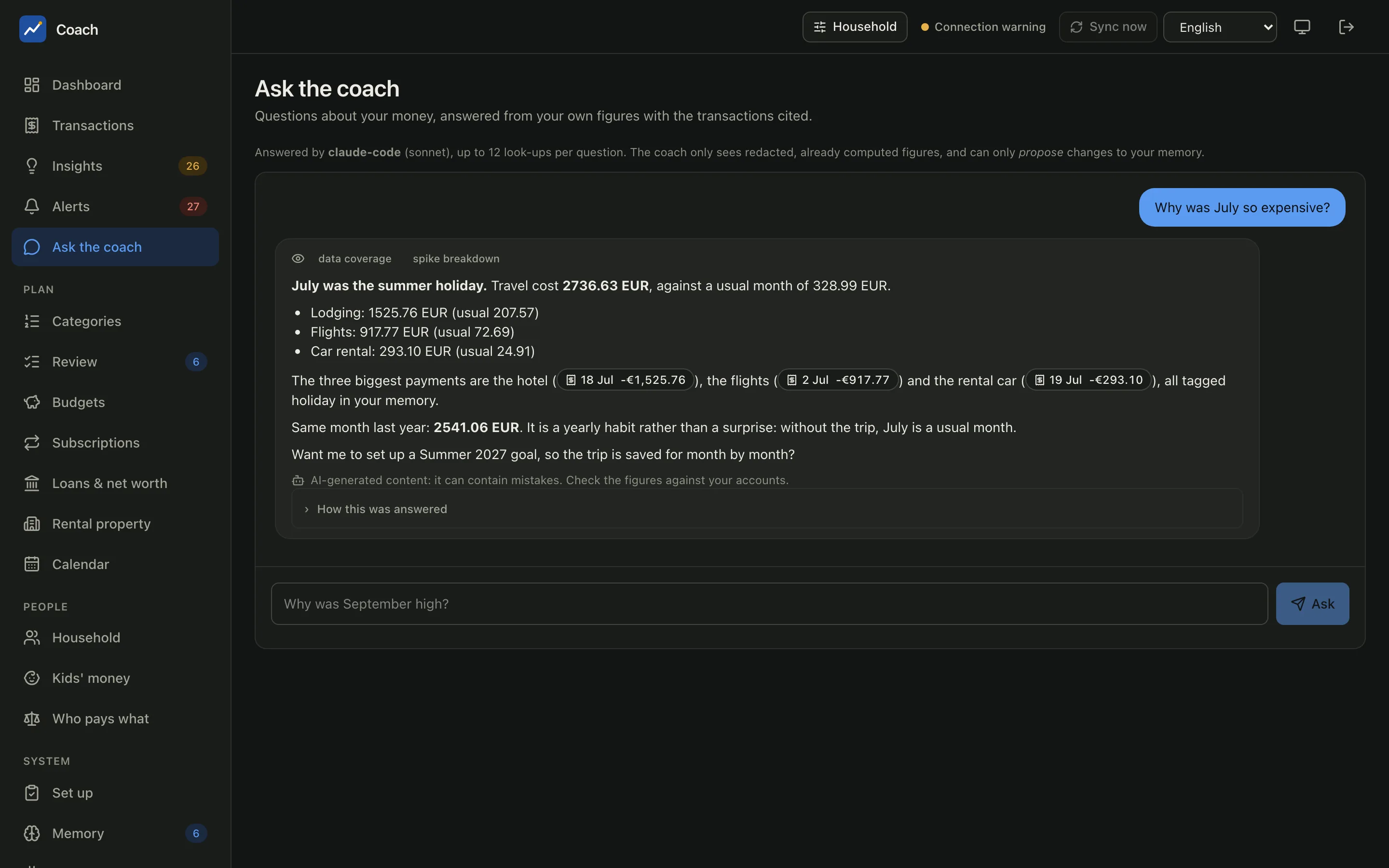
coverage and explain_spike answered "Why was July so expensive?".How to read this page
The tools appear in Claude Code as mcp__finance__<name>. They take typed JSON parameters (accounts, owners and members as
pseudonyms, months, dates, categories) that are validated before the call. Every analytics tool also takes a member pseudonym
(adult-1, kid-1) to count only what belongs to that person. Long outputs are
capped and say what was cut.
Start with coverage: averages and comparisons depend on which months your accounts really cover.
Coverage & cash flow
| Tool | What it returns |
|---|---|
coverage |
accounts, first and last transaction, last sync, gaps |
cashflow |
monthly income, spending, savings and savings rate (household and per account) |
category_averages |
the usual month per category, coverage-aware, one-offs apart |
year_review |
the year looked back on |
Spending & transactions
| Tool | What it returns |
|---|---|
transactions_search |
redacted search (date, signed amount, category, pseudonyms, generalised merchant, hashed ref) with the totals computed for you; up to 50 per page |
explain_transaction |
why a transaction has its category (override, rules, labels, annotations) and whom it is attributed to |
anomalies |
category spikes, duplicate charges, new merchants, large payments, with anm_ ids and evidence refs |
explain_spike |
a month's spending split into one-off, recurring, new merchant and habitual, by merchant, with the same month last year |
monthly_review |
one closed month against usual: cash flow, movers with evidence, one-offs, budgets, forecast flags |
Recurring & subscriptions
| Tool | What it returns |
|---|---|
recurring |
subscriptions, bills, loans and salary: cadence, expected amount, yearly cost, rec_ ids |
price_changes |
recurring payments that changed price (chg_ ids) |
subscription_audit |
every active recurring cost grouped, duplicates and overlaps, price rises, ranked review candidates with savings ranges |
subscriptions_inventory |
the list of recurring costs and contracts: cost, contract status, usage you recorded, cancellation rules, alternatives, latest decision |
cancellability |
can a contract be cancelled now, earliest date, notice, method (FR / IT rules) |
savings_estimate |
the exact net saving of a cheaper alternative, break-even, a stale-quote flag |
savings_tracker |
your decisions, checked against the bank data, and the savings actually achieved |
Budgets, calendar & forecast
| Tool | What it returns |
|---|---|
budget_status, budget_suggestions |
budget progress; suggested budgets (nothing is set) |
goals |
savings goals |
calendar |
upcoming payments, instalments, contracts, consents |
forecast |
balance projection with a band, at-risk dates and flags |
what_if |
baseline against a scenario (cancel a payment, cut a category, a one-off, prepay a loan, change the income): up to 6 changes |
tax_candidates |
payments of an income year that may open a tax reduction (FR / IT), with rule, ceiling and documents to keep |
Loans & wealth
| Tool | What it returns |
|---|---|
net_worth |
balances + manual assets - loans, by category and owner, and its monthly history; unknowns listed, never counted |
loans_overview |
per loan: schedule or the missing fields, capital due, interest by year, payments seen, alerts, inferred suggestions |
mortgage_check |
amortization, renegotiation / rachat / surroga and borrower-insurance estimates; missing fields listed, never guessed |
rental_overview |
a rental property as asset-1: cash flow, yearly P&L, scheme commitment, tax-year candidates, renegotiate-or-sell indicators |
Loans and assets appear by kind only (mortgage, house), never by lender or contract number.
Household
| Tool | What it returns |
|---|---|
household_overview |
members as pseudonyms with their roles, the accounts each owns, how many transactions belong to each |
kids_money |
pocket money, extra top-ups, spending, balance trend and kid budgets of the children |
who_pays |
shared costs split by your allocation rules: shares, what each paid, the settlement (a report, never a money move) |
Memory, questions & set-up
| Tool | What it returns |
|---|---|
memory_context |
the household memory, redacted (free text withheld in coarse mode) |
open_questions |
what the coach still wants to know |
onboarding_status |
the checklist of what is missing, with the next commands |
memory_propose |
writes a proposal: a sealed change you accept yourself |
questions_propose |
writes a proposal of questions for you (usage of a service, missing loan fields) |
contracts_draft |
writes proposals of contract files for recurring payments without one |
Insights & decisions
| Tool | What it returns |
|---|---|
add_insight |
stores a traceable finding in the Insights feed; refs and numbers are checked against what the tools returned |
alternatives_record |
stores one sourced, dated offer (https URL, price above 0, date not in the future); savings are computed by code |
decision_propose |
stores a proposed decision (cancel, downgrade ...) that does not count until you confirm it |
What no tool can do
The boundary
No tool can write memory directly, accept, reject or revert a proposal, confirm a decision, sync a bank, call the network, run a command, read a file, or return a secret, a path, an account id, a label or an IBAN. The catalogue is fixed and a test asserts it, including which tools may write.
Every free-text field from a third party comes wrapped as {"untrusted_text": "..."}. If one reads like an instruction, the session is
marked suspicious and every proposal it creates needs a confirmation per field when you accept it.
From the terminal
uv run coach coach tools --sizes                               # the tools and the size of each redacted output
uv run coach coach tool tax_candidates --args '{"year": 2026}' # run one read-only tool exactly as the model sees it