Search
Proton Faces exposes two search modes: free-text (zero-shot CLIP) and face search by example (ArcFace). Both run entirely locally.
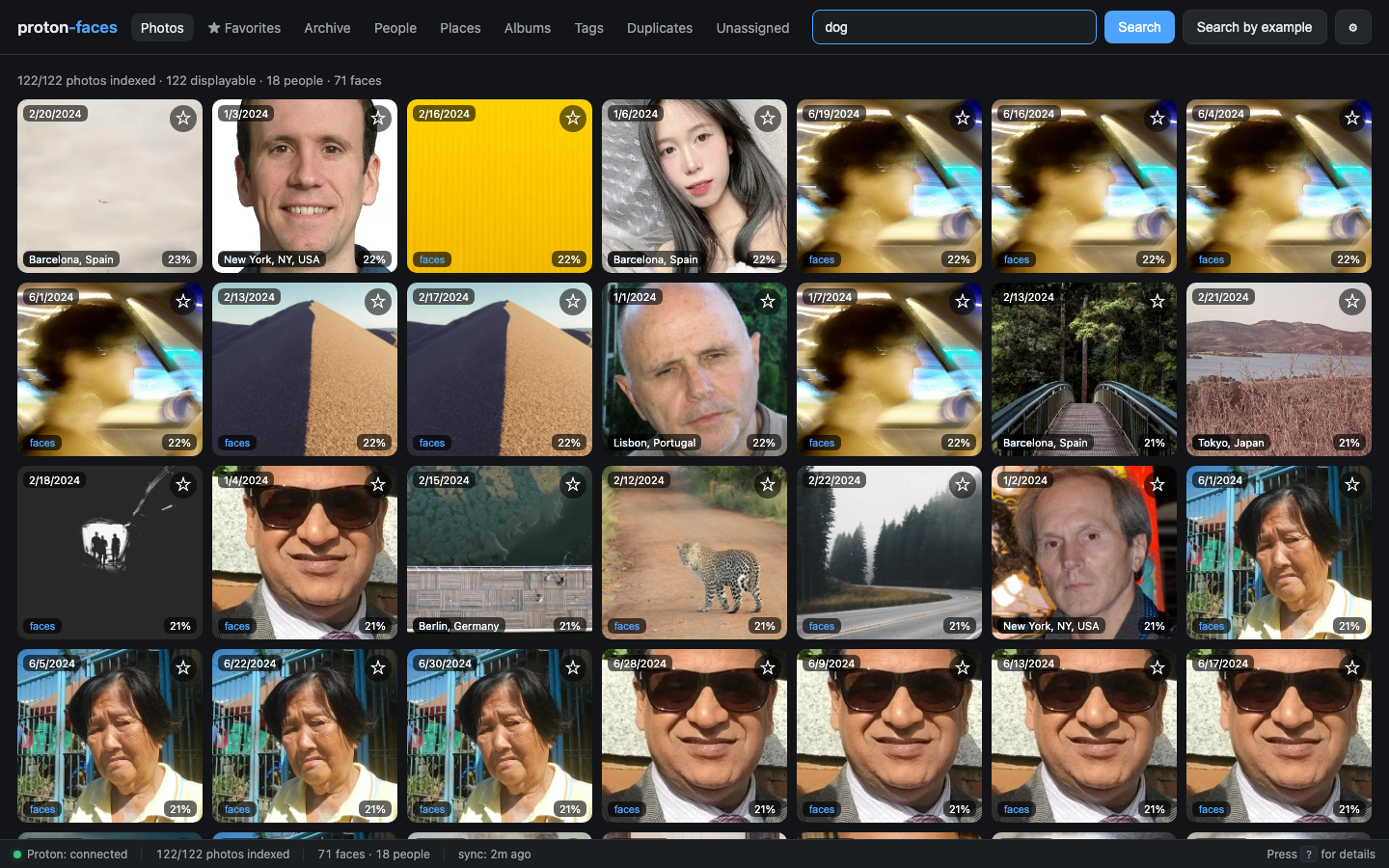
Free-text search (CLIP)
Type anything into the search bar at the top of the page and press Enter (or click Search). The query is embedded by CLIP's text encoder into the same 512-d vector space as every indexed photo, then ranked by cosine similarity.
What works
| Query type | Backed by | Notes |
|---|---|---|
"dog", "cat", "beach", "sunset" |
CLIP text–image similarity | Zero-shot, no per-photo labels needed |
"Lille", "Paris", "Berlin" |
GPS reverse-geocoding | Returns photos with a matching place name |
| Person name (People tab → open) | HDBSCAN clusters + your labels | Per-person photo grid |
| Map marker on the Places tab | GPS aggregation | Clustered markers, click to filter |
The query text is matched by CLIP and GPS in parallel — results are merged and re-ranked.
Demo: typing "dog", "beach", "Lille"
Type a word, the grid re-ranks in real time. No submit needed.
Performance
The CLIP matrix (every photo's 512-d vector) is cached in process memory. It's rebuilt only when the clip row count changes or after the 60-second TTL — even on a 100k-photo library the rebuild is ~88 MB of numpy data, sub-second.
Each search request computes X @ q (a single matrix-vector multiply) and returns the top-k uids. Typical latency: a few ms.
Face search by example
Click Search by example in the top bar. A modal opens with a dropzone.
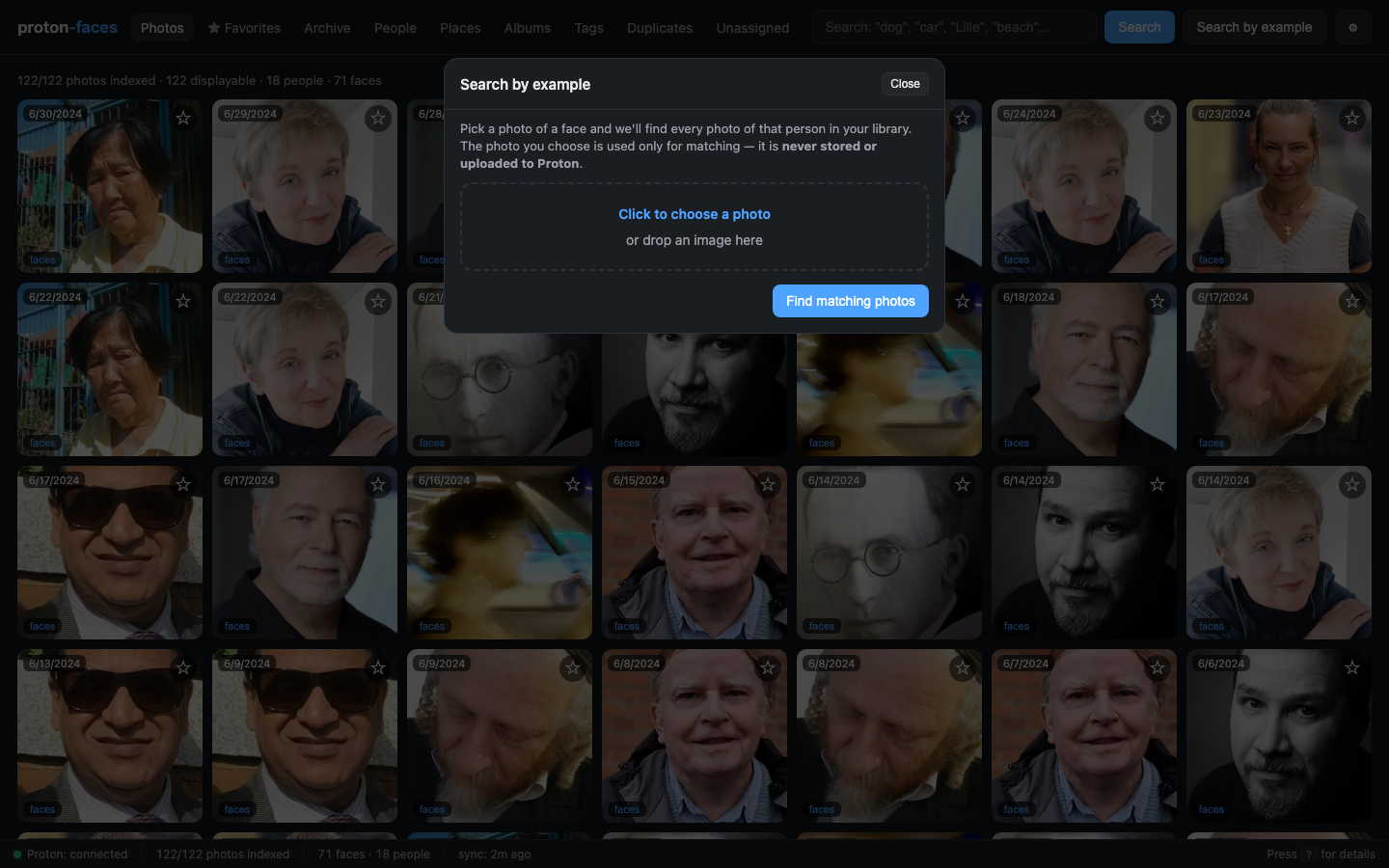
Drop a photo (or click to choose one) containing a face. The face is detected with RetinaFace, embedded with ArcFace, and the closest matches in your library are returned, ranked by cosine similarity.
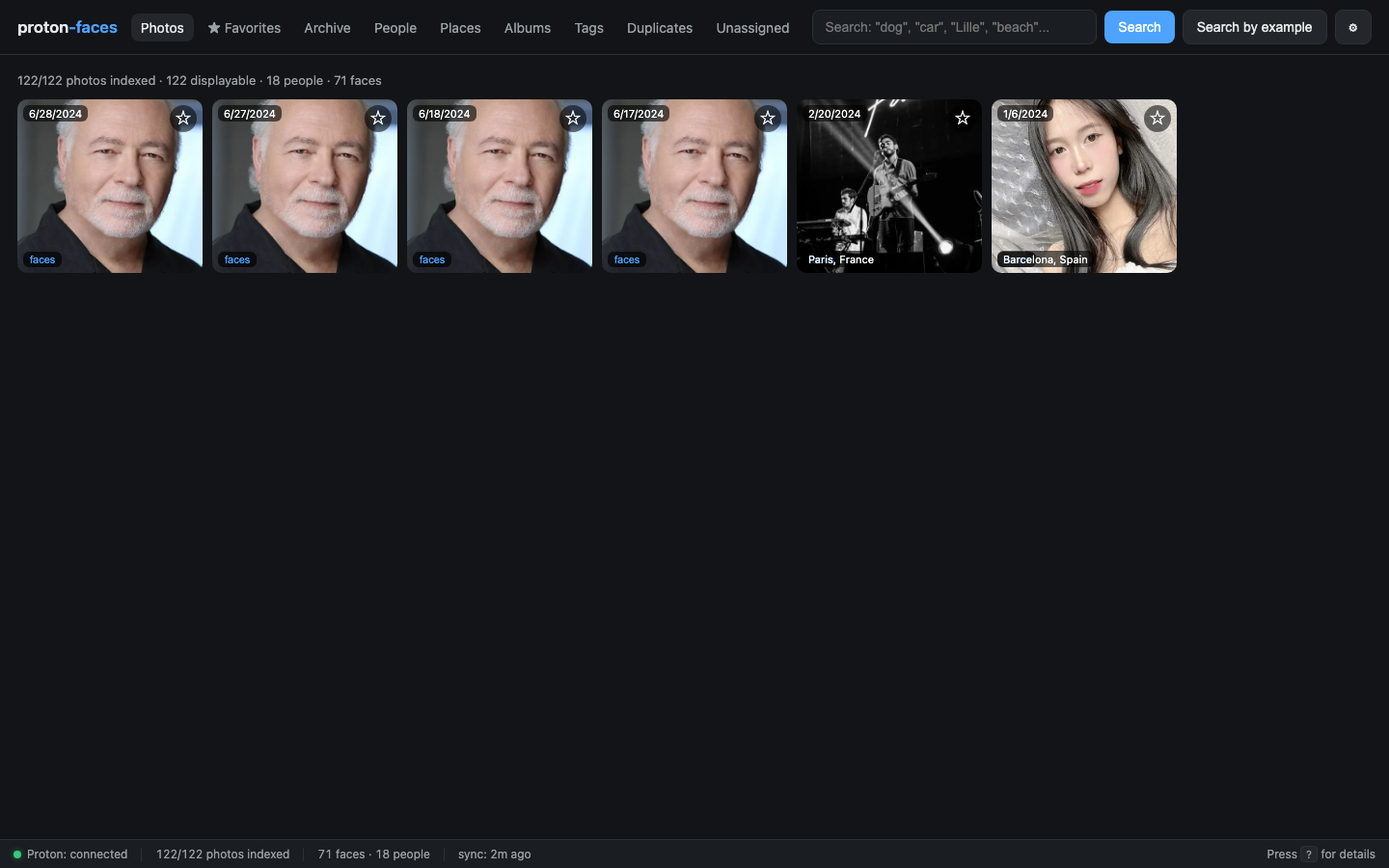
The uploaded photo is never stored and never sent to Proton. It is decoded in memory, embedded, then immediately discarded. The request only carries a 512-float32 embedding vector.
How CLIP + face search differ
| Free-text | Face search by example | |
|---|---|---|
| Query | Text | Image (must contain a face) |
| Embedding model | CLIP ViT-B/32 (text encoder) | ArcFace (R50, 512-d) |
| Returns | Top-k similar photos | Top-k similar faces → photos containing them |
| Latency | ~5–20 ms | ~50–200 ms (face detection per request) |
API endpoints
| Endpoint | Purpose |
|---|---|
GET /api/search?q=dog&limit=100 |
Free-text semantic search |
POST /api/search/face |
Face search by example (multipart upload) |
Both require authentication.
Tips
- Compound queries work. Type
"beach paris"and CLIP blends both concepts. - CLIP's zero-shot vocabulary is enormous. It can match "renaissance painting", "concert crowd", "labrador", "sunset over the ocean" without ever having seen those labels in your library.
- Place names win over text. When you type
"Paris", the GPS path is preferred over CLIP — there are usually more photos withplace='Paris, France'than photos that CLIP thinks look Parisian. - Face search needs a real face. Group photos where the face is tiny don't work well. Crop or zoom in.
Next: People dives into clustering, naming, and the per-person map.