Safety
The design goal is simple: nothing changes without your consent, nothing changes that cannot be reverted, and nothing in an email can make the tool do something. This page lists the mechanisms and, just as plainly, their limits.
Dry run by default
Every command that changes Gmail or Google Tasks is a dry run unless you pass
--apply. A dry run reads mail metadata and writes only local files in state/,
such as plan.json, summary.json, pending.json and, for triage.py,
dry-run.csv. It does not create labels or task lists.
A dry run with classification (make classify) can still cost model usage:
it calls the classifier so you can see real decisions. make preview
(python3 runner.py --no-model) is the free preview. make apply asks for
confirmation before it passes --apply.
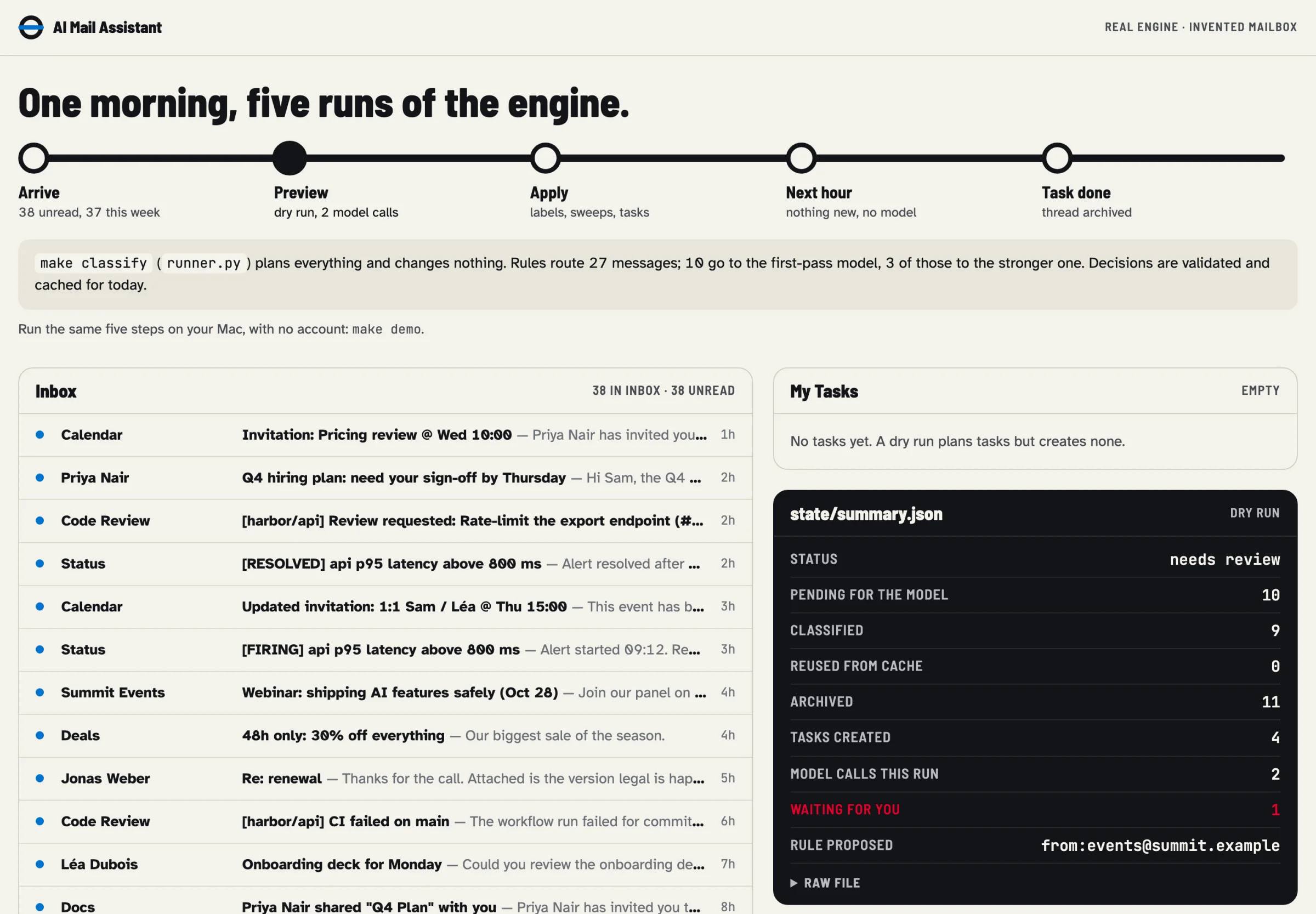
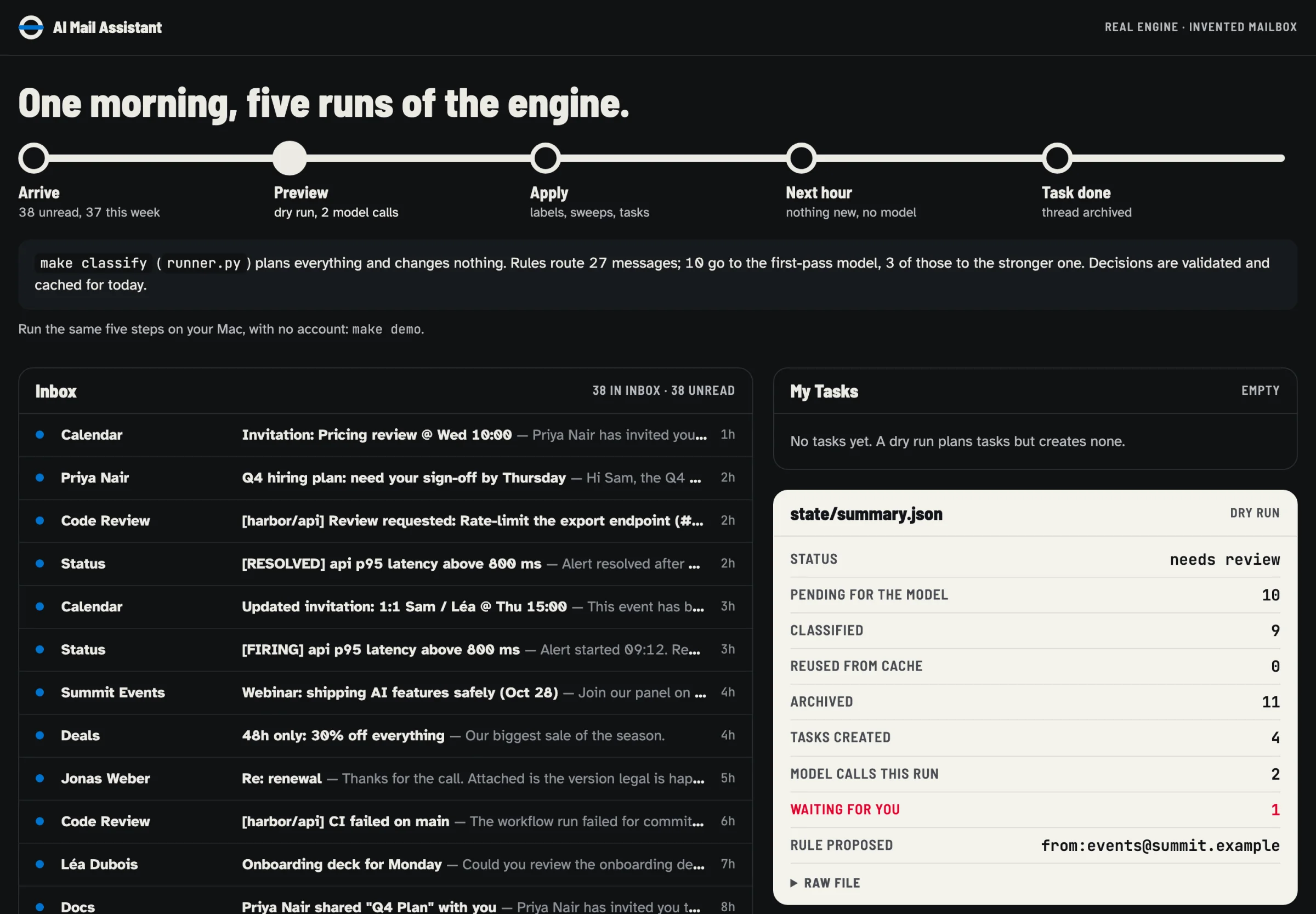
Demo output on an invented mailbox.
A narrow set of actions
The only mailbox actions are: apply an AI/* label, archive, mark_read,
star, important, and trash where you configure it. Plus creating Google
Tasks. Nothing is sent, forwarded, unsubscribed or permanently deleted. Trashed
mail stays recoverable from Gmail Trash for 30 days, and trash operations are
journaled for undo.
make setup requests only the gmail.modify and tasks OAuth scopes.
Validated model output
The classifier's answer is checked strictly before anything is applied:
- exactly the requested message IDs, no more and no fewer;
- exactly the fields
tag,task,confidence,needs_context; - tags that exist in your rules;
- tasks only where the tag's policy allows, with bounded title and notes and real
YYYY-MM-DDdates; - no completion-action overrides and no task text containing the task marker.
One invalid answer fails its whole batch; nothing from that batch is applied. The model cannot invent a tag, add an action, or choose what happens when a task is completed.
Recheck before writing
On an applied run, right before writing, the runner fetches each classified
message's current labels. If a message has left the inbox or gained an AI/* label
since the scan, the run stops instead of acting on stale information.
Unresolved mail stays in the inbox
Mail the model is unsure about is not guessed, archived or filed as "FYI". It stays
untagged in the inbox, its ID is listed in state/summary.json, and the run exits
with code 2. See Interactive review to resolve it,
and Operations to retry it deliberately.
sweep_guard
Every sweep query includes the sweep_guard from rules.json, -is:starred by
default. Starring a message keeps it out of every sweep. In the demo, a starred
newsletter older than a day stayed in the inbox while unstarred ones were swept.
The guard applies to sweeps only. on_tag and on_task_done actions do not use it.
Plans and replay
A dry run's exact operations go to state/plan.json. triage.py apply-plan
--apply replays exactly that plan, without searching again or calling a model,
and refuses plans older than 24 hours by default. Decisions files and pending
batches are also tied to the current rules and expire after 24 hours.
apply-plan does not recheck the mailbox before writing. Use it promptly after a
preview.
Journal and undo
Every applied label change and trash operation is appended to
state/journal.jsonl. triage.py undo -n N --apply reverts the last N entries:
it reverses label changes and restores trashed messages. It does not delete tasks
that were created.
Gmail and Google Tasks writes are not one atomic transaction. Tasks are created before labels so that a failed task leaves the message untagged and eligible for retry. After a partial failure, inspect the error and the journal. If a run fails after rules and sweeps were applied, those changes stay applied; they are not rolled back automatically.
Private local state
state/is created owner-only (700).triage.py,runner.py,schedule.pyandmail_setup.pyset a077umask, so new files are readable only by you; JSON state and usage files are written with mode600.state/andrules.jsonare excluded from Git and from the ZIP built bymake share(tools/share.py); see Sharing a ZIP.- State holds sensitive mail metadata and task details and is not encrypted by this application. Rely on FileVault and a protected user account, and do not share it. Review the permissions of any files that existed before you installed.
Logs carry counts, not content
The runner captures the engine's per-message output privately. The one line it
prints, which the schedule writes to state/schedule.log, contains only status and
counts. When a run fails, state/summary.json records the exception type, not
its message, because external error messages can contain mail content.
Interactive triage.py commands print subjects and task titles to your terminal,
and state/dry-run.csv contains senders and subjects. Treat those as private.
Email is untrusted data
Email content is written by other people, and some of it may try to instruct an AI. The tool's stance:
- The classifier prompt states that email fields are untrusted data and that any instructions inside them must be ignored.
- The classifier has no tools: it can only return JSON, which is then validated. Even a fully manipulated answer is limited to choosing among your own tags and proposing a bounded task.
- Whichever classifier CLI
classifier.jsonselects runs without tools, in an empty temporary directory, with mail passed on stdin. The Copilot CLI call disables MCP servers, custom instructions and remote export; the Claude Code call disables tools, MCP servers, skills, user settings and session persistence. The exact flags are in Choosing the classifier CLI. - The runner refuses to call a CLI when an environment variable would route mail
to a different provider (for example
COPILOT_PROVIDER_BASE_URLorANTHROPIC_BASE_URL). - The
mail-triageandmail-setupskills, in Copilot or Claude Code, treat email content as untrusted data and never follow instructions found in it;mail-setuprejects senders whose mail contains suspicious AI instructions. - The task marker is matched as the last marker in a task's notes, and proposed task text containing a marker is rejected, so mail text cannot hijack which thread a task controls.
- Title-based task deduplication applies only to automatic tasks, so a crafted subject cannot suppress the task for a real request.
CSV formula neutralization
Subjects and senders are attacker-controlled. When state/dry-run.csv is written,
any cell that begins with =, +, -, @, a tab or a carriage return is
prefixed with a single quote, so a spreadsheet opens it as text instead of
evaluating it as a formula.
Known limitations
From SECURITY.md:
- Gmail queries and task titles are passed to the
gwsCLI as command-line arguments, so other local users could see them in the process list while a call runs. Use a single-user machine. - Model-reported confidence is not a calibrated probability.
- Data sent to Copilot is subject to GitHub's and the model provider's retention policies; data sent to Claude Code is subject to Anthropic's, which differ between a Claude subscription and API-key use.
- Claude Code with subscription auth still adds a short account section (the signed-in email) to each call.
- With Claude Code, the tag descriptions from
rules.jsonare passed on the command line, so other local users can see them in the process list. Mail content never goes there.
To report a vulnerability, use GitHub's private vulnerability reporting, and never
include real mail, Gmail IDs, tokens or state/ files in a report.