Try the demo
The demo runs the production engine end to end on an invented mailbox. It needs no Google account, no Copilot or Claude account and no network access, and it makes no paid model calls.
The demo uses the Copilot path
The demo's stand-in classifier imitates the GitHub Copilot CLI, so the demo
always runs with "cli": "copilot", whatever your own classifier.json
selects. A real installation can classify with Claude Code instead; see
Choosing the classifier CLI. The engine, the
validation and everything after the model call are the same for both.
You can also step through a recorded run in the browser: open the online demo console.
Run it
From the project folder:
The engine needs Python 3.10 or newer. macOS ships Python 3.9 as python3; if the
demo stops with the engine needs Python 3.10+, run it with a newer interpreter,
for example the one make setup installs (see Getting started).
Options:
| Option | Effect |
|---|---|
--quiet |
Do not print the commands and their output. |
--out run.json |
Also write a JSON snapshot of every step (the mailbox, tasks, summary and model calls after each step). |
--workspace DIR |
Keep the throwaway workspace in DIR (new or empty) instead of a temporary folder, so you can inspect its state/ afterwards. |
By default nothing is kept: the workspace is a temporary folder that is deleted at the end.
What is real and what is fake
The demo copies triage.py, runner.py and classifier.json into a temporary
workspace, sets "cli": "copilot" in that copy, and writes the demo rules.json
there. It copies the two programs in demo/fakes/ into the workspace's bin/
folder and puts that folder first on PATH. They stand in for the real CLIs:
demo/fakes/gws- A stand-in for the Google Workspace CLI. It serves the invented mailbox from a
JSON file and answers the exact Gmail and Google Tasks calls
triage.pymakes, with a small Gmail query evaluator (in:,is:,label:,from:,to:,subject:,newer_than:,older_than:,OR, negation and parentheses). Nothing leaves the machine. demo/fakes/copilot- A stand-in for the GitHub Copilot CLI. It reads the real prompt
runner.pysends on stdin and answers with a scripted classification for each message, in the same JSON event format the real CLI produces. Its token counts are estimated from text length and are not real usage.
Everything else is the production code path: rule matching, sweeps, the pending
batch, the classification cache, escalation, validation, the mailbox recheck,
task creation and deduplication, task-completion sync, the journal and
state/summary.json.
The mailbox and rules live in demo/demo_mailbox.py. The mailbox belongs to an
invented "Sam Rivera" at an invented company. All domains use the reserved
.example top-level domain. The scripted classifier answers, including their
confidence values, are written by hand in that file; they are not output from a
real model.
What each step shows
The demo prints each command with its output, then a one-line recap per step. The figures quoted here come from a demo run on the invented mailbox. Task due dates depend on the day you run it.
1. Arrive
38 messages in the inbox, all unread: requests from colleagues and a client, calendar traffic, code-review notifications, monitoring alerts, document shares, receipts, internal announcements, newsletters, promotions, a meeting-notes bot, and one 12-day-old message outside the default 7-day window.
2. Dry run preview
triage.py run shows the deterministic part on its own: rules tag 27 messages,
the promotions are archived as soon as they are tagged, sweeps plan to archive the
resolved alert and the code-review and newsletter mail older than a day, and 10
untagged messages are written to state/pending.json.
runner.py repeats the scan and classifies the 10 pending messages. The cheap
model receives all 10 in one call. Three come back as needing context or below
the confidence threshold, so they go to the stronger model in one call, with
their plain-text body. Two of those are resolved; one ("Friday?") is still
ambiguous and is held for review.
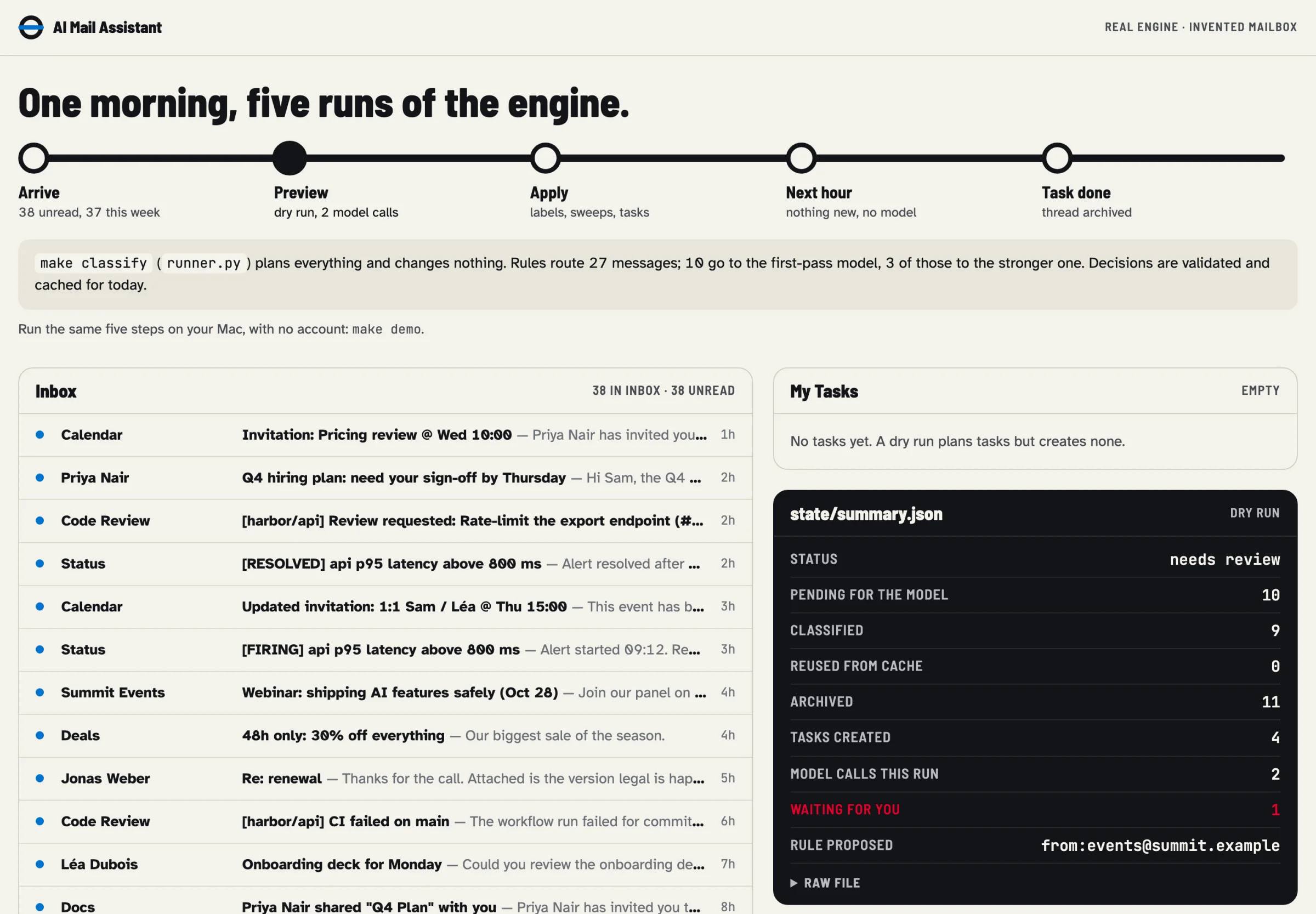
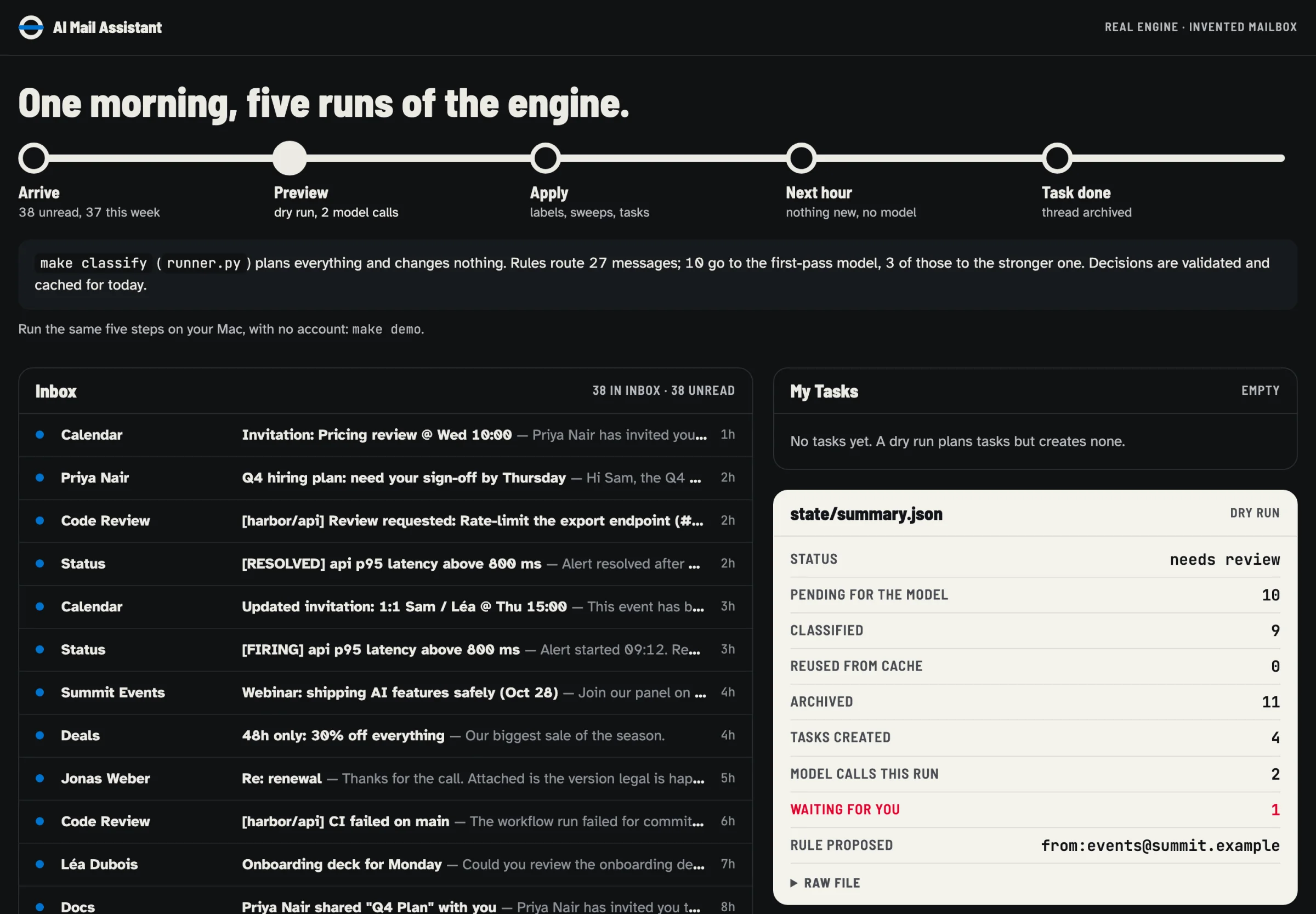
Demo output on an invented mailbox.
The runner prints one line:
[runner] dry-run needs_review: 9 classified, 11 archived, 1 unresolved; summary: ~/ai-email-assistant/state/summary.json
Nothing in the mailbox has changed. The 11 archives and 4 tasks are planned, and
the 9 validated classifications are saved in the same-day cache. A three-message
bulk sender that no rule knew yet (events@summit.example) is listed in the
summary as a rule candidate that requires approval.
3. Apply
The applied run reuses the 9 cached classifications, so it makes no model call. It rechecks that each message is still in the inbox and unlabeled, creates the 4 tasks, applies labels, and archives 11 messages. The inbox goes from 38 to 27.
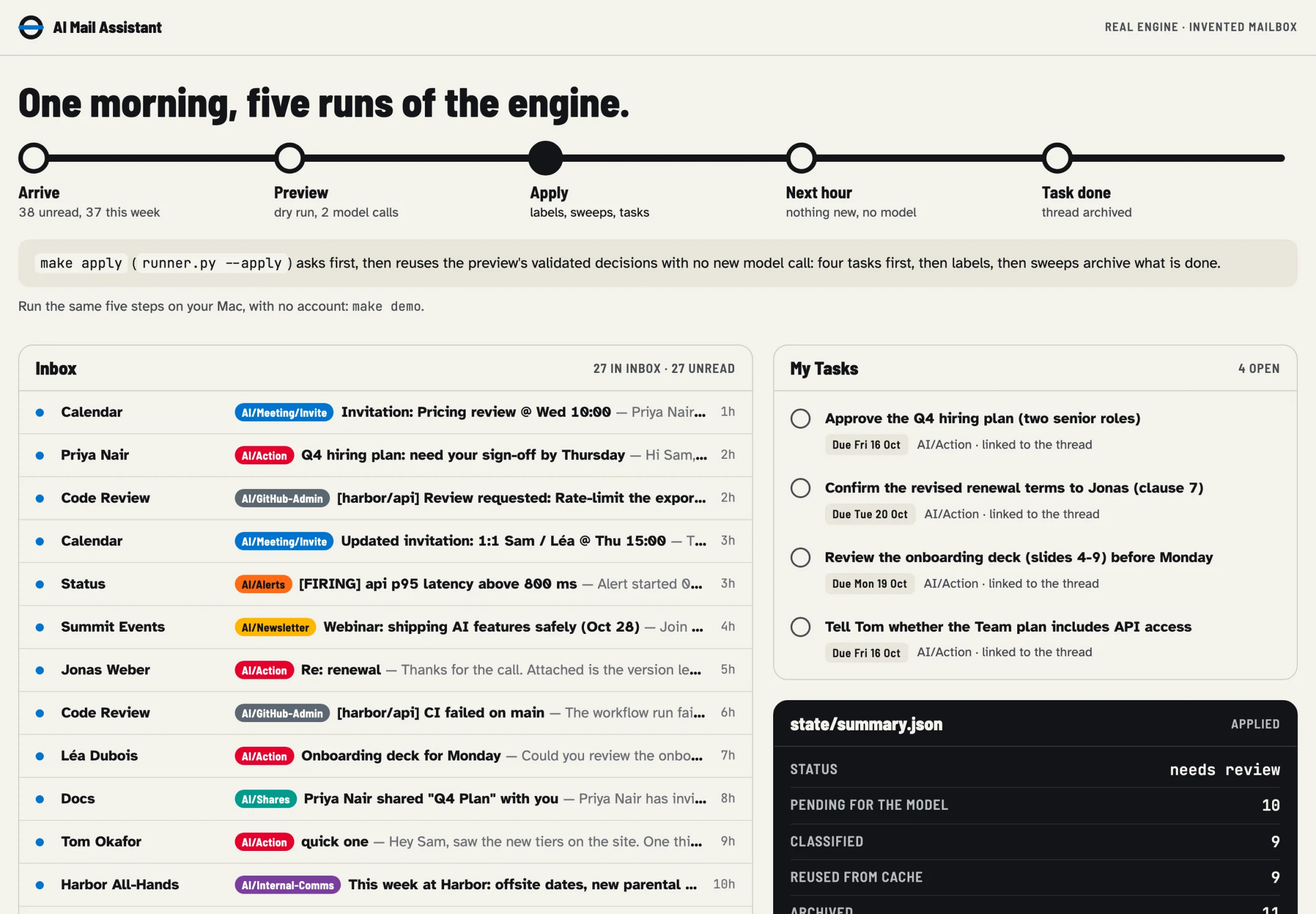
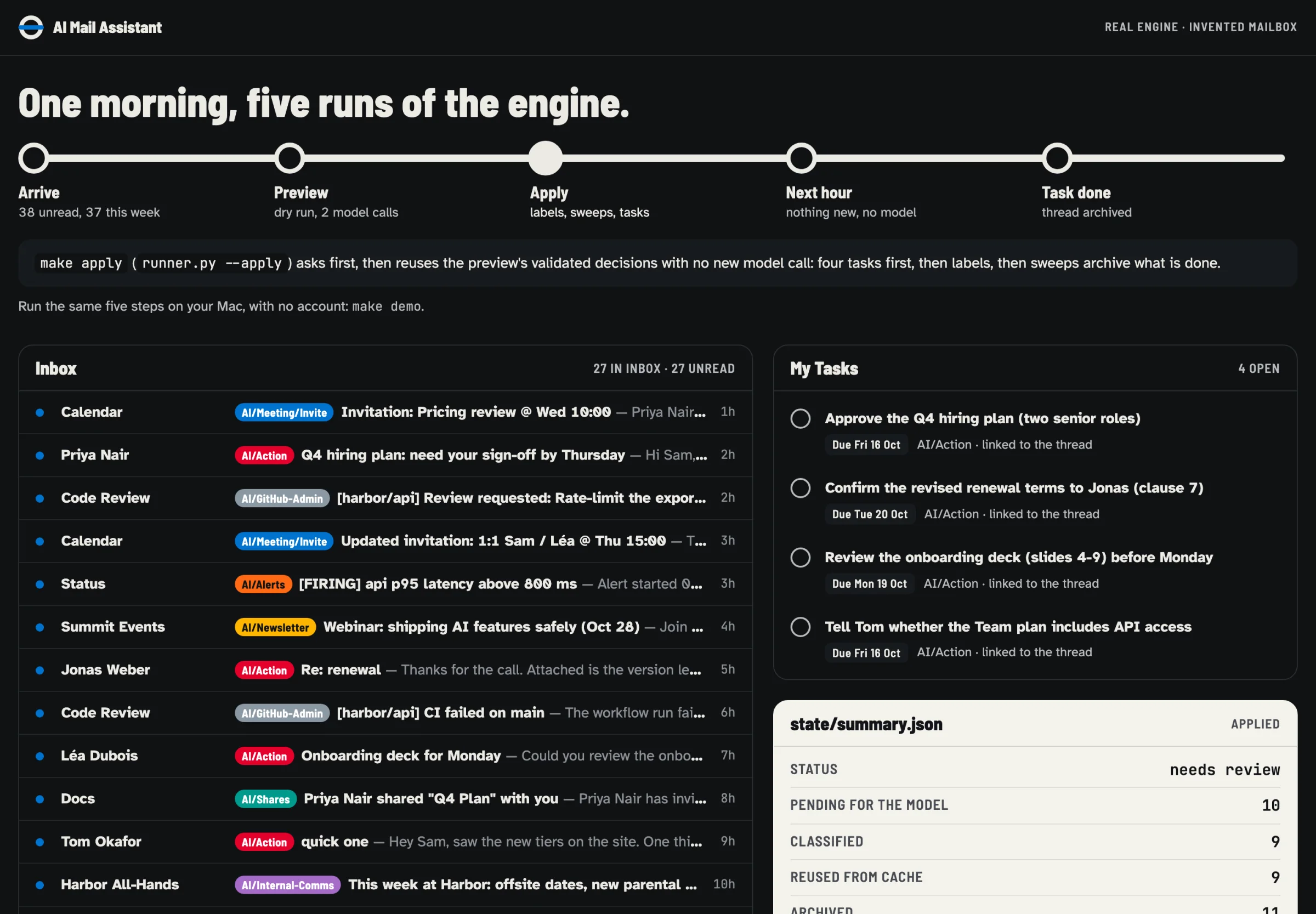
Demo output on an invented mailbox.
--usage-report sums the recorded model calls: one call per model in this run.
In the demo the token figures come from the stand-in and are estimates, not
billing data.
4. Quiet hour
The next run finds nothing new. The one ambiguous message was already held for review today, so it is not sent to a model again. No model call is made. The run exits with code 2 because one message still needs a person.
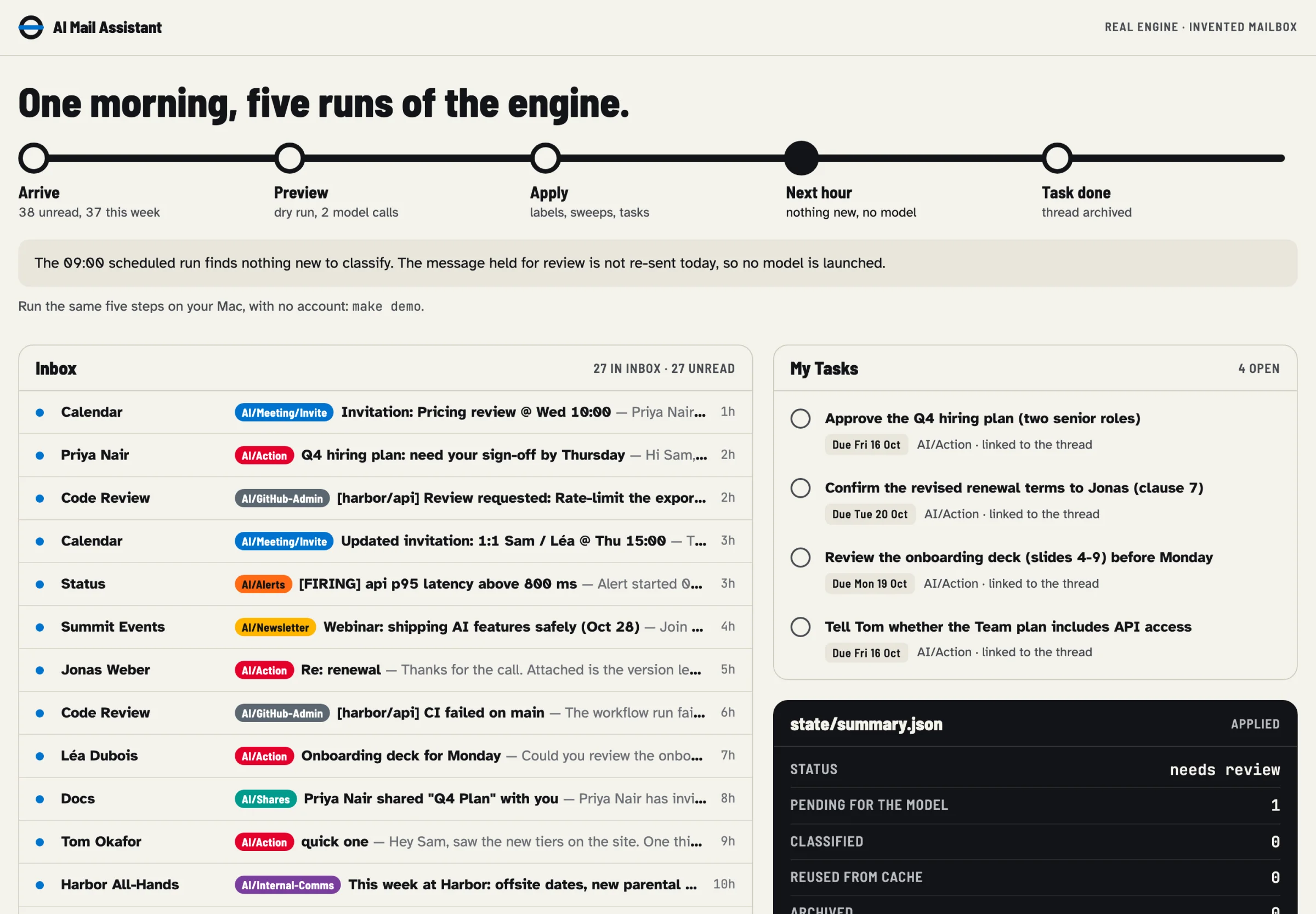
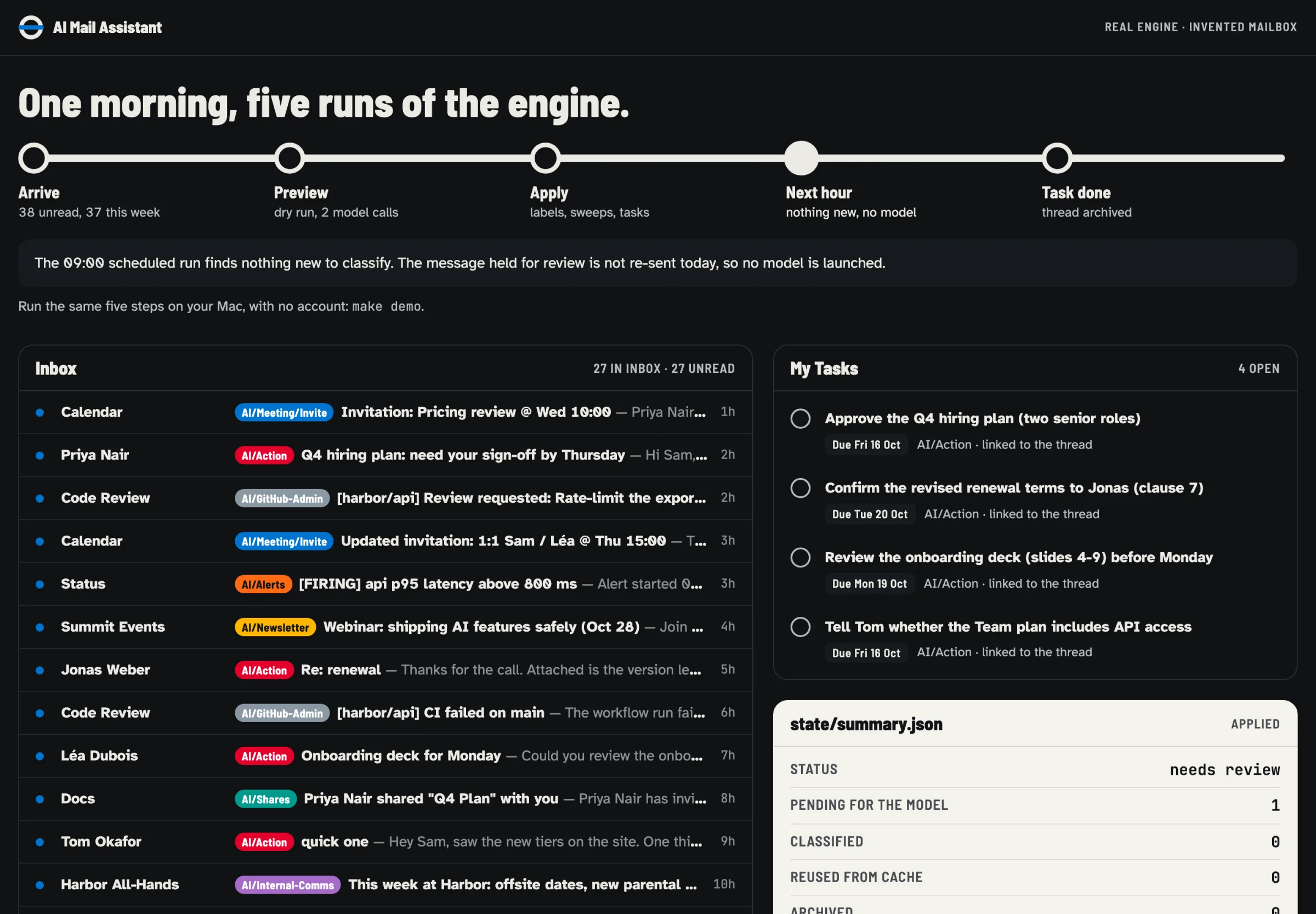
Demo output on an invented mailbox.
5. Task done
The demo marks the task "Approve the Q4 hiring plan (two senior roles)" as
completed in the fake Google Tasks, then runs runner.py --apply again. The sync
step sees the completed task and applies the Action tag's on_task_done action
(archive) to that thread. The inbox goes from 27 to 26. Still no model call.
Reading the result
After the steps, the demo prints a recap such as:
[preview] Dry run: rules plan, the model classifies what rules cannot: status=needs_review model calls=2 tasks=0 in inbox=38
[apply] Applied run: cached decisions reused, labels and tasks written: status=needs_review model calls=0 tasks=4 in inbox=27
[quiet] The next hour: nothing new, no model call: status=needs_review model calls=0 tasks=4 in inbox=27
[done] A completed task archives its thread: status=needs_review model calls=0 tasks=4 in inbox=26
status=needs_review on every step is the "Friday?" message: it is deliberately
left untagged in the inbox rather than guessed.
To look at the state files the engine wrote, keep the workspace:
State files explains each one.